
Demographics of POV characters (UPDATED 2026)
Previously on Hannah-is-a-massive-nerd-avoiding-real-life-commitments: a breakdown of the point of view characters across every Craft Sequence novel, updated for Dead Hand Rule! Check it out here!
Ahem.
Now that I’ve gone through Dead Hand Rule, it’s time to tackle the basic demographic breakdown of POV characters. If you’ve visited this page before, you might notice that it’s considerably different now. I originally planned to stick to the previous format that analysed gender, race, magic use, and LGBTQ+ representation over the series as a whole, but found that adding in the new book wasn’t particularly illuminating now the series is so long. I’ve kept a little of that analysis, but for visualisation I’ve instead broken each demographic down by book in shiny new bar charts! I hope you enjoy.
If you want to look at the original data, it’s here in a non-editable Google Sheet. It’s messy, but so am I. You’re welcome to use it if you want to do your own analysis.
Standard disclaimer: this is basic, I’m as far from a data scientist as you can be. I barely scraped a pass in Quantitative Data Analysis 9 years ago at grad school, and deeply regret taking the class in the first place. But, as with many things in this fandom, we’re building from the ground up.
Let’s get started. Spoilers for all published novels ahead.
Gender
Probably the easiest to identify, gender has been categorised based on pronouns used in the text, and any references to gender. This gives us female, male, N/A, and for the first time in Dead Hand Rule, non-binary.
Looking at the series as a whole, of the 49 POV characters, 25 are female, 22 are male, and 2 are non-binary. The male/female split is more even than I expected, as I always think of the Craft Sequence as female-dominated. However, when you look at the page distribution specifically it’s closer to my expectation - 2452.5 pages (73.4%) are from the perspective of a female character, and only 854.8 pages (25.6%) are from a male POV. This proportion has changed by less than a percentage point since the Craft Wars series started, and our two non-binary characters have only 6.5 pages (0.002%), solely in Dead Hand Rule.
Looking at each book individually shows a much more interesting picture.
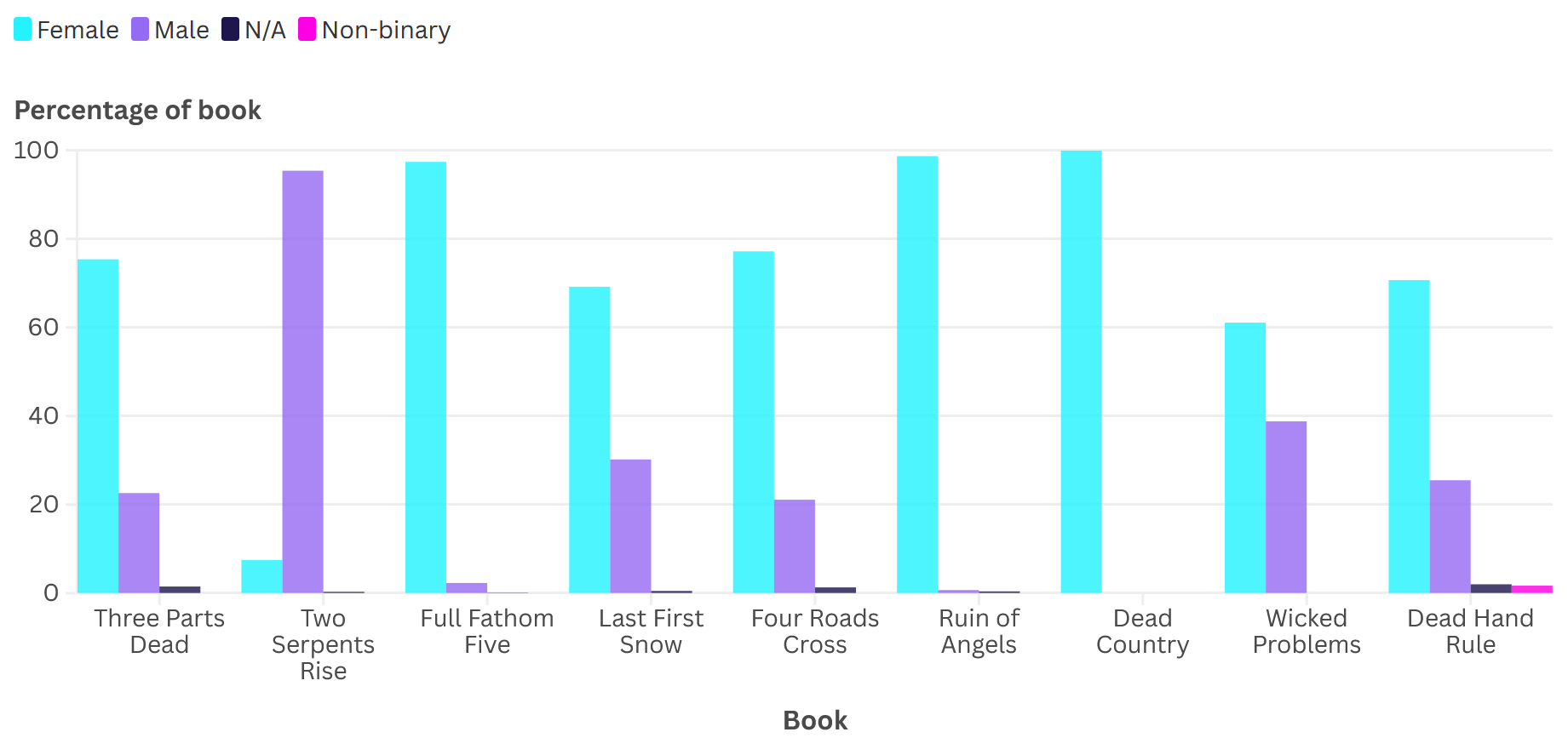
Other than Two Serpents Rise (hey 93% Caleb POV), each book is from a primarily female POV. Wicked Problems is the closest to even, and that still has us at nearly 60% female POV characters and around 40% male.
The top three for female dominance are Dead Country (100% Tara POV), Ruin of Angels (98.7%) and Full Fathom Five (97.4%). Of those, Ruin of Angels has the highest number of POV characters at 12, and every character who has above 1% of POV time is female (in order: Kai, Zeddig, Izza, and Raymet).
Race
Lines of race and ethnicity in the Domain don’t necessarily line up with the understanding of them in our world. Not to mention, even within our world there are different understandings and categorisations depending on your own background and upbringing. So, for this demographic I’ve done my best to represent the characters in broad terms.
Let’s take them one by one in alphabetical order:
Alikand Talbeg - Essentially North African / Arab, these characters are largely from Alikand and identify as Talbeg. I’ve specified Alikand, because Izza is also Talbeg, but from the Southern Gleb (sub-Saharan Africa) and is described as culturally and ethnically distinct from our Alikanders.
Archipelagese - Formerly ‘Kavekanese’, I decided to broaden this out even though the only characters in this section are indeed from Kavekana. Kavekana is part of an Archipelago, and the general culture appears to be Pacific Islander inspired (despite not being in the equivalent of the Pacific…)
Black - Honestly, I don’t know if people in the Domain would use our categorisations of Black and White; they have different histories as a world, people in-universe tend to use descriptions like Iskari for white characters, and Izza is referred to as Talbeg and from the Southern Gleb rather than Black. However, this analysis exists in our world so I have chosen to categorise both Tara and Izza as Black for this essay.
Dhisthran - Dhisthra is Craft!India, and despite his English sounding name, Raz mentions being Dhisthran (alternate spelling, Dhistran) in Four Roads Cross. However, as he has so few pages, in this analysis Dhisthran is included in the ‘Other POC’ category.
Quechal - In many ways the easiest, as characters identify themselves as Quechal and we hear a bit about the history of the Quechal peoples. Quechal best aligns with indigenous Meso-American in our world; while there appears to have been at least some Craft!Spanish immigration to Southern Kath (see Ortega in the spirecliffs), the majority of the population in Dresediel Lex is Quechal and indigenous to the areas.
Schwarzwalden - This one may be incorrect, but when Eberhardt Jax is first introduced, Kai notes that he is darker in colouring than most of the people who have pitched to her so far. This could mean a broad range of skintones and racial backgrounds, but given how diverse the series is at the point of his introduction, I always took it as Jax being a person of colour. As he has so few POV pages, he/Schwarzwaldens are part of the ‘Other POC’ category for the purposes of our analysis.
Shining Empire - A new category for Dead Hand Rule, the Shining Empire is Craft!China. We have a couple of pages from Ran, who is most definitely from the Shining Empire, and a handful from Allegra Chen. From her surname I have placed her as being ethnically from the Shining Empire, but this is not confirmed in the text. However, as they have so few pages, they are also categorised under ‘Other POC’ here.
White - Much like ‘Black’, this feels like a weird category in-universe, as it isn’t really used as a description or racial category. People who originate in Iskar (France) and Camlaan (the UK) definitely have pale skin and would be counted as White in our world, but there are a lot of Northern Kathic characters who fit the same description but whose heritage doesn’t match up with our world. Patterns of migration to the New World in the Domain don’t match our history of colonisation and slavery. However, much like the ‘Black’ category, I’m using ‘White’ because this analysis exists in our world.
There are a few POV characters who don’t fit ethnicity because they are gargoyles or demons, and one (the old man/assassin in Dead Hand Rule) who has no physical description given and thus his race and ethnicity are unclear.
Across the entire series, in terms of POV we have:
2 Black characters - 982.5 pages (29.41%)
21 White characters - 865.5 pages (25.91%)
10 Quechal characters - 647.3 pages (19.38%)
2 Archipelagese characters - 590.5 pages (17.68%)
5 Alikand Talbeg characters - 191.5 pages (7.73%)
5 Other POC characters - 20 pages (0.6%)
5 characters where race is unapplicable or unstated - 45.5 pages (1.36%)
Despite the disparity in number of POV characters, you can see that Black and White characters have similar proportions of page time overall (25-29%) as do Quechal and Archipelagese characters (17-19%). Kai does the heavy lifting for Archipelagese, and Caleb does the same for the Quechal list.
But what’s the picture when you look solely at POV characters with more than 1% of page time? Well, while the numbers of characters in each category change quite dramatically, the percentages of page-time surprisingly don’t.
2 Black characters - 982.5 pages (29.41%)
5 White characters - 735.5 pages (22.02%)
1 Archipelagese character - 588 pages (17.6%)
2 Quechal characters - 548 pages (16.4%)
2 Alikand Talbeg characters - 181 pages (5.42%)
As for comparing each individual book:
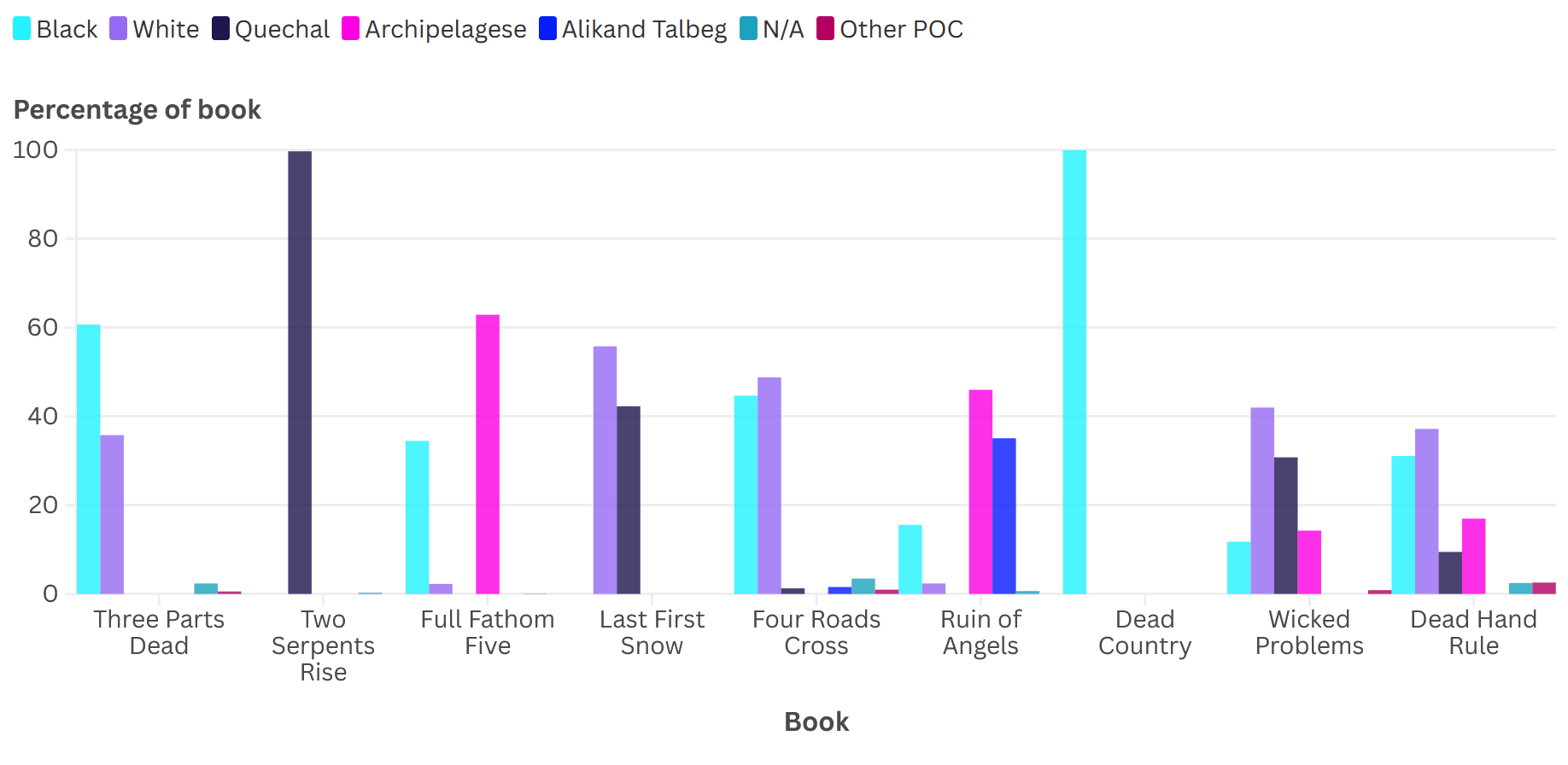
Given that the first few books follow a different cast of characters, it’s unsurprising that the race of POV characters in each book has significant variation. As expected, Two Serpents Rise and Dead Country have the highest proportion of one racial background, as Caleb and Tara narrate almost the entirety of each book respectively. Every other book has a broader variety of characters, leading to a more even spread of representation. Thus far, Dead Hand Rule is the only book where no one race reaches 40% of POV pages. Last First Snow is the whitest book, largely because Elayne Kevarian has over 50% of the page time.
Magic use
This one started out as a fairly easy categorisation, but has become more complicated as more and more characters don’t seem to fit into the Craft/Applied Theology split. Some use both, some seem to use another form of magic, some have no magic but appear to wield it through technology, and some have none. Sometimes I had to make a subjective call as to where they would fall in the categorisation.
For example, even though Tara is both a Craftswoman and Priestess of Seril, I have placed her as solely a Craft user. She prays, sure, but she doesn’t really use Applied Theology, so I haven’t counted it here.
Dawn, on the other hand, does use both - or at least the principles of both. She could have been classed as ‘other’ given her proto-skazzerai thing, but as she views it through the lens of Craft and Applied Theology I’ve placed her in ‘both’. Previous versions of this essay categorised her within Craft.
Applied Theology here means both priests and worshippers - so we count Temoc and Abelard, but also Bescond in her few pages. However, I’ve classed Caleb as ‘other’; his scars are Applied Theology, but he can use them to wield the Craft. Perhaps he could be considered ‘both’, but he can’t actually use Craft, just manipulate it. So he (and Teo) are classed as ‘other’, along with the Alikanders, Sir Gav (I can’t work out what the knightly powers are), our few non-human POV characters, and Ran.
In previous analyses I haven’t included the technology category, and the characters who use it have so few pages it almost doesn’t seem worth it, buuuut I decided to throw it in for Jax, Ley, and Vane. It’s insignificant in the overall series, but cool to see in their respective books. What I mean by this, is characters who are not in themselves using magic in the way we would expect from our Craftswomen and priests, but who are so expert in using and developing technology that in some ways they might as well be wielding magic.
Over the whole series, this breaks down as:
15 use Applied Theology - 1267.5 pages (37.94%)
10 use Craft - 1121.3 pages (33.56%)
13 use another magic - 433.5 pages (18.96%)
7 have no magic - 532.5 pages (15.94%)3 use both Craft and Applied Theology - 181 pages (5.42%)
3 use technology magic - 9.5 pages (0.003%)
The split between Craft and Applied Theology was WAY closer when Dawn was classed as solely a Craft user (38.2% v 37.99%), but moving her into ‘both’ hit the Craft numbers. Dawn is the heavy hitter for her new category, bringing 80% of the pages.
Book by book is a fun analysis, and shows how many books in the ‘Craft’ Sequence have very little Craft being used at all:
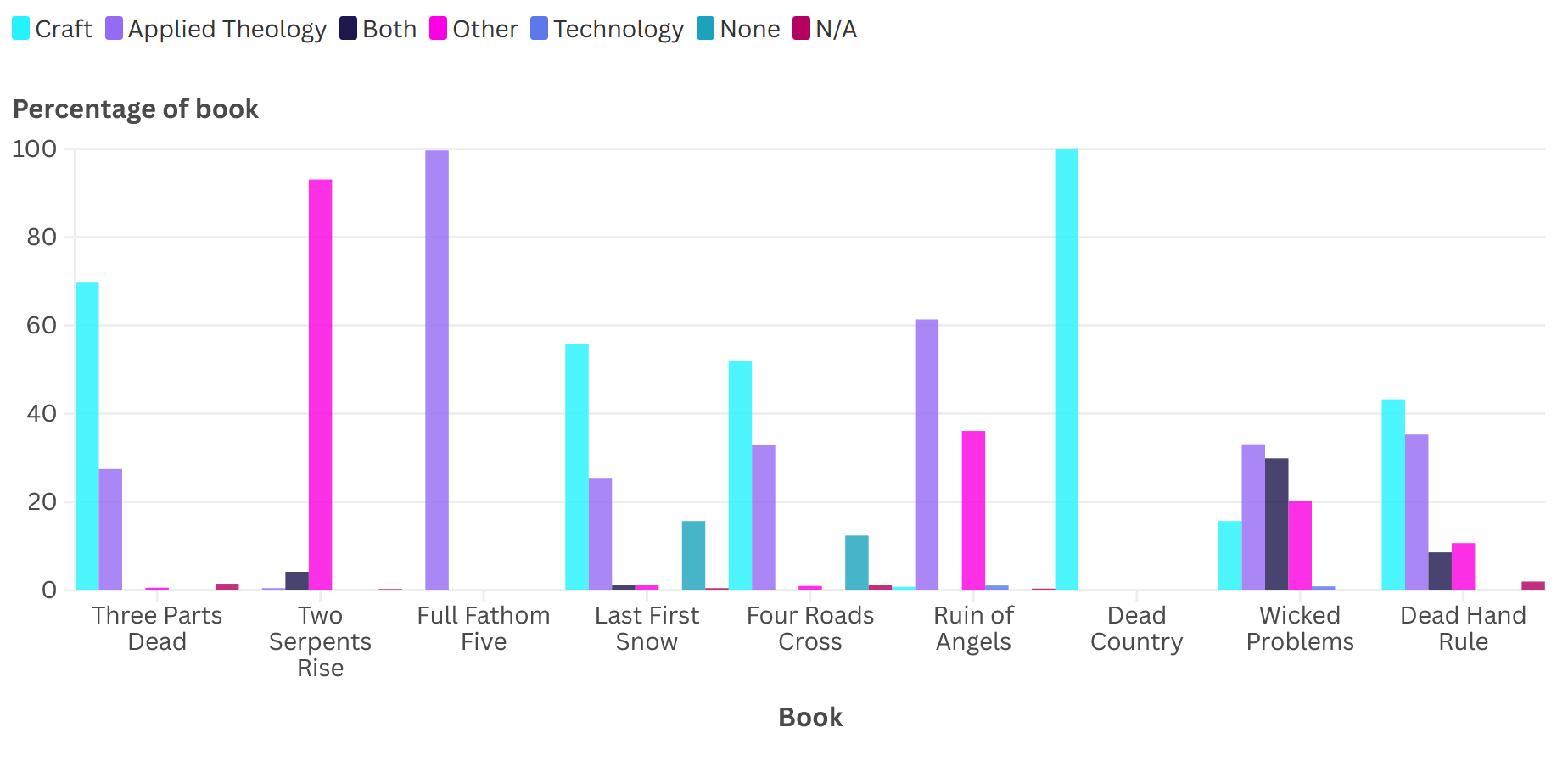
Unsurprisingly, Dead Country has the most representation of Craft because Tara is the sole POV. Craft also leads in Three Parts Dead (Tara and Elayne), Last First Snow (Elayne), and Dead Hand Rule (also Tara). If you remove Tara’s POV, Last First Snow is the only majority Craftsperson book.
Applied Theology dominates in Full Fathom Five as both Kai and Izza use some form of this magic, as does Edmond Margot in his minimal POV. There is only half a page from an unidentified POV, so every other page is an Applied Theologian.
Two Serpents Rise and Ruin of Angels have a significant proportion of ‘other’ magic, with Caleb bringing his unique use of Quechal scars to Two Serpents Rise and the Alikanders bringing their delvey-bookish-angelic magic to Ruin of Angels. Wicked Problems has the most equal distribution, with no single kind of magic reaching 40%. This would probably be different if I had kept my old classification of Dawn.
LGBTQIAP+ Representation
I wavered for a while on how to categorise this one, and concluded that it would be based on clear, on-page LGBTQIAP+ representation versus anything other than that. I’m therefore not marking any characters as explicitly not LGBTQIAP+. There are very likely some cis-het characters, but until Gladstone tells us that’s how they identify then I’m not categorising anyone that way. Sorry in advance to my friend, who is convinced that Caleb and Abelard are into each other - it’s not clearly on-page, so they are not counted. Yet. Gladstone, if you’re reading this, you can make my friend’s dreams come true. I will also argue that Dawn has some kind of non-straight feelings for Tara, but it’s subtext at the moment.
(Off-topic but gang, we need a shorter yet inclusive acronym)
As an example of what is or isn’t counted here, let’s look at Tara. Tara is arguably checking out Cat in Three Parts Dead, but it wasn’t until Wicked Problems and she was very obviously crushing on Kai on-page. In my mind, she was always queer but I didn’t classify her as such until Wicked Problems came out. I do, however, backdate representation, so Tara is considered a queer character in her earlier books.
As a change in this version of the essay, I have decided to split out sexuality and gender. This is not intended to imply any thoughts about certain groups not belonging in the rainbow, but because I know some readers want to know which books, for example, have a trans character as a lead.
The phrasing used below for sexuality is clunky, but it’s the best I could come up with and it is now 1am so it’s all you’re getting.
Over the entire series we have 10 POV characters with queer sexuality on-page representation (Tara, Kai, Zeddig, Raymet, Teo, Hasim,Alethea Vane, Ley, Umar, and Kopil [for his third of a page]) and 4 trans or non-binary POV characters (Kai, Jax, Ran, and Feltan). As Kai is in both lists, this gives us a total of 13 POV characters with on-page LGBTQIAP+ rep, across 1579.3 POV pages or 47.27% of the series. That means the series is almost half queer! If Gladstone gives my friend Caleb and Abelard, we can make it majority queer. Please, Gladstone.
When we look only at those characters with more than 1% of page-time, we have 4 queer characters (1 of whom is trans), representing 1551.5 pages and 46.44% of the series. This is a third of our top POV characters, but have nearly half of the POV pages. A win for the LGBTQIAP+ among us.
Looking at the individual books, I need to give a caveat for Three Parts Dead, Four Roads Cross, and Dead Country that we find out later that Tara is queer, so I’ve counted her but it’s kinda in retrospect. I don’t want anyone to read expecting clear rep and being disappointed.
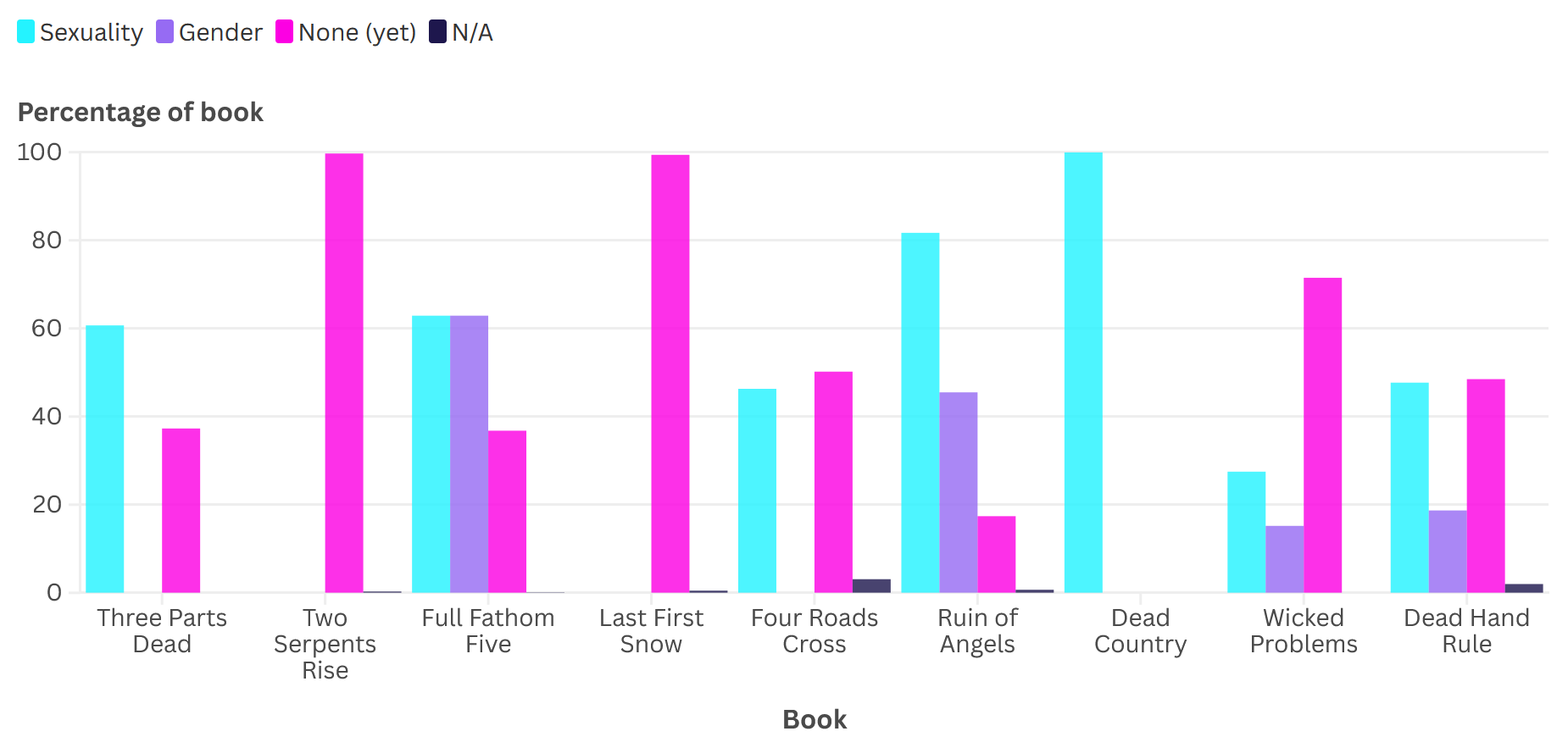
But taking that caveat, we have five books that have more on-page queer characters than non-queer: Three Parts Dead (Tara, in retrospect), Full Fathom Five (Kai), Ruin of Angels (Kai and Zeddig lead, with a sprinkling of Raymet and the tiniest bit of Tara, Ley, and Vane), Dead Country (Tara, again in retrospect), and Dead Hand Rule (Tara, NOT in retrospect, and Kai are the major ones, but we also have a few pages from Feltan and Ran).
Two Serpents Rise and Last First Snow are the least queer books, in terms of POV pages. Whilst we do get non-POV representation in both (Teo and the King in Red, separately) they do not have POV pages and thus I cannot count them.
And that’s it for now! As in the previous post, you are welcome to use this data for your own analysis, just link back here.
What do you think? Let me know - and don’t forget you can subscribe to be the first to hear about new articles and fun projects in the pipeline. Like what we do here? Tips welcome on ko-fi to help pay for the site!





Caleb and Mal are apparently “twin grails” and factor into the vampires’ plan - but what does that mean? How does it link in with the knights we’ve met across the series, immortality, and the Twin Serpents?