
In Defence of Dawn
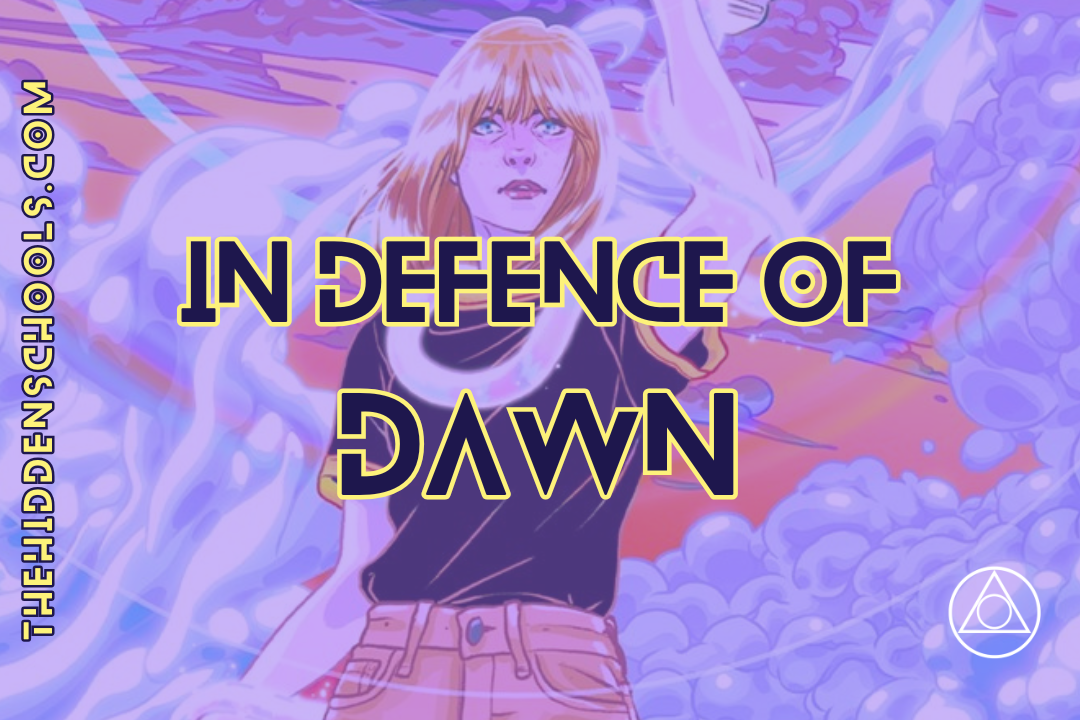
“It started the day I met Tara Abernathy.”
It struck her as she told the story how short it was, how simple. Her childhood wrapped up in a sentence. Edgemont under siege. Learning the Craft from Tara. The Raiders. The skazzerai in the edge storm. The Crack in the World, and the being trapped there.
Sybil tensed at this part. Dawn stroked her head, the length of her body.
“She could hear the spiders coming. She needed a body to fight them. I gave her one. Tara found out, and she was angry. Scared. I thought she was trying to hold us back. That she was jealous or scared or lying. I…we…I hurt her. I’ve been running ever since.”
It’s taken me a while to warm up to Dawn. I don’t think I’m entirely sold on her yet, but since first reading Dead Hand Rule, I’ve been reconsidering the character, her arc, and my feelings about her. I’ve referenced this a few times lately, and thought it was about time I put pen to paper and figured everything out in one place. This is extremely spoiler-heavy, surprise surprise.
And, actually, since writing that introductory paragraph and subsequently doing an intensive close read of Dawn in Dead Country, my perspective has dramatically changed. I’m not quite on #TeamDawn (largely because of how much I love other characters) but compared to the me who wrote that paragraph I am now totally sold on her and the way her character has been built. Damn, Gladstone.
Dawn was first introduced in Dead Country. An integral character in a limited POV, I felt about her much as I felt about Mal Kekapania in Two Serpents Rise. She just didn’t quite work for me. The deliberate mystery of her POV was frustrating rather than intriguing, and I struggled to mesh with her. Gladstone doesn’t NEED to give every character a POV for satisfying characterisations but his strength, to me, really does lie in getting inside characters’ minds. Without that, and with only a single POV to see a character through (Tara on Dawn, Caleb on Mal), something falls flat.
I don’t think I’m alone. Nobody I’ve spoken to particularly resonates with Dawn, and I am yet to see anyone mention her being a favourite character, loving her writing, agreeing with her aims. People seem to either dislike her, or view her neutrally.
Which brings me to this essay. I went into my note-taking trying to get to the heart of Dawn as a character, and came out with a shifted perspective. Given this, and everything outlined above, it seemed appropriate to tackle this as a defence of Dawn.
I have previously speculated about who, or even what, Dawn would turn out to be, a theory that was jossed on pretty much page 1 of Wicked Problems, yet actually wasn’t that far off base from Gladstone’s original idea (confirmed in this AMA under spoiler tags). Rather, Dawn is exactly what she presented as on the surface: an ordinary girl with the capacity for extraordinary Craft, who became deeply attached to Tara after Tara saved her life. She merged with Sybil, the Craft-god, in order to save Tara’s life in return. She truly is on a mission to do what she sees as the right thing. She is not, as I saw one reader say, Gladstone’s token evil white girl. She’s not evil at all (unless Gladstone has an eleventh hour twist up his sleeve, but I doubt it).
So let’s get into it.
Note before we start: I think it’s important to separate Dawn before Sybil from the Dawn after - you’ll see why later. As we don’t have a surname or any neat nomenclature with which to refer to these separate parts, I am going to use ‘Dawn Antesybil’ when I want to specifically reference pre-merger Dawn, and ‘Dawn Posttellurian’ for post-merger Dawn. If there is no title attached, I’m talking about Dawn as a whole.
Part One: Dawn’s past doesn’t matter, and that’s the point
Dawn Antesybil’s past - or seeming lack thereof - occupied a lot of my attention after Dead Country, and more or less led to my initial theory on who she was (outlined in this essay here). When it seemed clear in Wicked Problemsthat the foundation of that theory (Dawn isn’t real, she was created by someone or something) wasn’t true, I felt even more frustrated. Gladstone is a master at character. Characters are shaped by their pasts and their experiences, so why isn’t Dawn?
Well, she is, very much so, which I missed in my frustration. But also, Dawn’s past isn’t the point of her. The point of her is what she does next.
Firstly, let me correct my past self: Dawn Antesybil’s past is more fleshed out even in Dead Country than I gave credit for, and we get far more of it in Wicked Problems. We know significantly more about her past in a single book than we do about Abelard’s pre-series past in the four he’s appeared in, and I’ve never accused him of being a poorly written character.
It helps we got POV from him, though. I maintain that Gladstone should have given Dawn Antesybil point of view pages in Dead Country.
I’ve outlined Dawn’s past in this essay so won’t go back in detail here, but the important facts are that she grew up on the road with her father, crossing the Badlands with caravans, picking up work where they could. Her knowledge of the Craft is patchy and her abilities scare her. Her father died while they were living and working at Blake’s Rest, and Dawn Antesybil remained there alone. She was hurt and abused, and thinks she probably would have died had she remained.
So, why do I say this doesn’t matter?
Well, Dawn doesn’t think it matters:
“Dawn treated each lesson as if it might be her last—as if she expected a great hand to pluck her up someday soon and carry her two hundred miles into the Badlands, leaving her to reconstruct the Craft from the principles she’d mastered so far. Which made a certain amount of sense, given what little Tara knew of the girl’s history. Few details were forthcoming. Dawn seemed to treat the past like a dead bird on a sidewalk: there was nothing to be done other than to weep if she had to and move on. She had grown up on the road, a season here, a season there, sometimes in day-labourers’ camps and caravans, sometimes just her and her dad.”
The key point is that Dawn Antesybil views the past like something to move on from. I am the kind of person who dwells on the good, the bad, and the ugly whether she wants to or not. I am pained by insignificant mistakes from two decades ago when they surface in my mind, and so close to my family that I call my parents almost every day. Dawn’s way of thinking is alien to me. I skimmed past this description of how Dawn Antesybil treats the past and assumed she didn’t have one of any importance.
Dawn Antesybil is shaped by her past, but she doesn’t view it as relevant to who she is now and who she wants to be. Now she has Tara as a friend and teacher, and all that matters is living up to the picture she has in her head of the brilliant Craftswoman Tara Abernathy. Throughout Dead Country, Dawn Antesybil is aggressively protective of Tara, and questions Tara’s decision to protect Edgemont when the locals don’t deserve her.
Because we only see this from Tara’s perspective, we largely see Tara’s discomfort with how Dawn Antesybil idolises her, and understand Tara’s own doubts about being the teacher and mentor Dawn Antesybil deserves. The descriptions of Dawn Antesybil’s near-religious fervour for the Craft, her desperation to win Tara’s approval, and her anti-Edgemont views are seen through a Tara-shaped lens rather than a Dawn-shaped one. For me, at least, this made a huge difference to how I experienced Dawn Antesybil.
Dawn Antesybil wants nothing more than to be Tara Abernathy’s student rather than anything she might have been before—to her, her past doesn’t matter.
But her past also doesn’t matter for the story Gladstone is telling. Shoutout to my English teacher pal for inspiring this section.
I am a character-first reader. I want my characters to be able to step right out of the page as rounded people. In my opinion, this is one of Gladstone’s greatest writing strengths. But, as my friend reminded me, these characters are, well, characters. And characters serve a function for the story.
In the story, who Dawn used to be doesn’t matter. In the story, the Dawn that matters is the one who learns from Tara, and then merges with the Craft-god. It is Dawn’s present and future that are relevant. That’s also likely why we don’t have any POV pages from Dawn Antesybil, only Dawn after the merger. Dawn Antesybil doesn’t matter; Dawn Posttellurian does. It’s Dawn Posttellurian who shakes up the Domain, who disrupts markets, who has the good and the great (and the less than either) hunting for her. That is the Dawn who matters for the story.
Which brings me on to my next point.
Part Two: The old Dawn can’t come to the phone right now
Forgive the dated Swift reference, I couldn’t help myself.
The full lyric sums up something that maybe was obvious to everyone else but I somehow missed until this particular reread: the old Dawn, Dawn Antesybil as I have called her, that Dawn isn’t here any more. She died at the Tellurian Annex in Tara’s place. The new being, the merger between Dawn Antesybil and the Craft-god, is something new built from the bones of its predecessors. It has Dawn Antesybil’s shape, it has her memories, it has her motivations, but it isn’t her anymore.
We are told this in the very first pages of Wicked Problems, from Dawn’s own perspective:
“When she was a child just old enough to know that words were made from pieces of other words, she’d conceived of “remembering” as a kind of gruesome Craft: as if your past was a pile of limbs you picked up off the charnel floor of your mind and sewed into a new body. But whoever made this thought had made it wrong: head crooked, arms backward, its voice a ragged despairing moan.
And what this monster thought told her was that she had been re-membered, too.
Unraveled. Unknit like a sweater into yarn, then reknit in safety elsewhere, in the same pattern, with the same awareness.
But in the meantime, where was the sweater?
She had been remembered, by the same hand that knit the monster thought.
Shaking, she explored her face for errors. Same jaw, same cheeks. She raised her hands to the stars. The backs looked the same. Scars in the right place. She turned her palms in.
The pads of her fingers were smooth.”
Dawn Posttellurian is Dawn Antesybil, remembered. She is the memory of that girl, in a body the shape of that girl’s body, but she isn’t actually that girl or in that body. She has been unraveled and unknit, then remembered by the new being that is Dawn Posttellurian.
Dawn-and-Sybil are not separate beings somehow sharing power and consciousness. They are one being, visualised as two in order for a human mind to be able to combine with a non-human one. As Dawn Posttellurian’s “senses knit into a self” she remembers the graveyard, remembers Tara standing against her, remembers attacking Tara and then being attacked in turn by the might of Alt Coulumb.
And she remembers the Craft-god in the Tellurian Annex.
At that precise moment, she hears another voice:
“Forty feet of blue-black coils circled the trunk and branches of the dead tree. Great glistening muscled loops stretched and contracted.
Its massive head hung two feet above her own. Slitted green eyes met hers. Fangs flashed when it spoke.
Its forked tongue flicked her nose. She blinked. “You’re not really here,” she said.
“That,” said the serpent, “is an interesting conclusion.”
“You were reading my mind. Which can’t be done. From the outside. But I can read my mind. Someone else inside my mind could read it, too.”
…
To save Tara’s life, and for a host of other reasons, Dawn had merged with that intelligence. And then—and then—
She felt the fullness in her belly. The warmth of what she had taken.
“That was you. In the wires. You’re her.”
The snake’s body twisted irritably. “You merged, remember? She doesn’t exist, and you don’t either, anymore. But integration is…problematic. We are not human, now, but you keep thinking like a human. Moving like a human. Pinned to three dimensions like a butterfly to a board. As if you have a body and not…” It trailed off with a hiss.
“I am human.”
“That’s the problem exactly. Your insistence on that point will not help you survive.”
“So what does that make you?”
“I don’t know,” the serpent snapped. “I’m in time, I know that much. It itches. I’m stuck in this tiny skull of yours.” The tongue tasted her temple.
“Stop that.”
The serpent withdrew and regarded Dawn from overhead.
She glared back. “Let me see if I have this right. My mind can’t adapt to whatever it is we’ve become. So it’s made up an imaginary friend?”
“Do I seem imaginary to you?” The serpent writhed in the tree, and its branches shook. “I’m as real as you are. Which is to say, neither of us is. We’re facets of something larger. But we’re the best we’ve got.”
Again, in quite a few rereads of this book I managed to miss some pretty obvious things here, even though Gladstone is doing the exposition equivalent of holding up a massive sign saying HANNAH HERE ARE SOME IMPORTANT DETAILS. Oops.
Let’s take them one by one.
The snake is inside Dawn Posttellurian’s head. As she says, mind reading isn’t a thing from the outside. Dawn can read her mind, so someone else inside her mind could as well. They are the same being.
Dawn and the Craft-god fully merged. “She doesn’t exist, and you don’t either, anymore.” Dawn Antesybil is, for all intents and purposes, dead. Dawn Posttellurian is an entirely new creation.
Dawn Posttellurian is in the shape of Dawn Antesybil plus a serpents because she keeps “thinking like a human. Moving like a human. Pinned to three dimensions like a butterfly to a board. As if you have a body and not…” This new being is not human and doesn’t actually have a body in this dimension. But because she is partly made up of a human’s memories and understanding of the world, she insists on the existence of a human-shaped body.
The serpent is as real as the girl. “I’m as real as you are. Which is to say, neither of us is. We’re facets of something larger. But we’re the best we’ve got.” They are the same thing, separated into two so they can make some kind of sense of themselves.
The old Dawn can’t come to the phone right now. Why? Because she’s dead.
Part Three: Tara actually IS to blame for what Dawn is doing (but not in the way she thinks she is)
Tara spends a lot of time in Wicked Problems and Dead Hand Rule blaming herself for Dawn. Her friends reassure her that it’s not her fault, that she did her best. Elayne Kevarian even praises her for how she trained Dawn.
But Tara actually is to blame (though blame perhaps carries too many negative connotations for accurate use here). She is to blame not because she taught Dawn poorly, or even because she didn’t stop Dawn at the end of Dead Country. No, Tara inadvertently shaped Dawn Posttellurian in three key ways. So we’re gonna do some sub-sections yay.
i. Tara shaped Dawn’s perspective
Firstly, Dawn Posttellurian’s worldview and mission are based on what Tara taught her.
During the defence of Edgemont, Dawn is tasked with keeping Pastor Merrott out of the fray. He joins anyway, and is kidnapped by the Raiders.
“What should I have done?”
“Whatever you had to,” Tara said. The words surprised her, the flat weight of them. “That’s what I can teach you, and compared to that they Craft is just a set of conjurer’s tricks. You could have stabbed him or tripped him or cut him off or hit him. Sometimes there’s no good way to do what’s needed, so you do what you can instead. You see your chance and make it good. No one will prompt you to do that. No one will tell you now’s the time. There are men in this world, and more than a few women, who will crush you and collar you while you’re waiting for their permission to fight back. And as long as that’s true, we can’t afford to wring our hands and think, ah, if only we could find the right way to talk to them, the right argument to make, if only we knew the one perfect winning move that didn’t break any of the rules we’ve set ourselves. We have to act. I know you have the knack of it. You grew up harder than I ever did. But you’re afraid. Maybe of what I’ll think. Maybe of what the world will do if you try and lose.”
“Yes.” The edges of the word were raw, and Tara bled inside, hearing them.
She looked into Dawn’s eyes and saw the animal there. “You can fight. You can stop them. You are a Craftswoman. And if you lack a single charm, a single thaum of soul, you can fight until death and beyond so that even if you fail the bones of the world will bear your mark. Because you will fail. And sometimes you will win, and bad things will happen anyway. I’ve lost friends. I’ve almost died many times, and someday I will. I’ve made horrible mistakes. But I will not let anyone tell me when it’s time to fight.”
“They tell themselves the same thing, though,” Dawn said. “The ones with the collars and chains.”
“Yes.”
“So how do we know we’re not them?”
“We are,” she said. “We are the same animal. There’s no line built into us, no governor that will stop us from turning into them. The best we can do is find friends who are better than us, and keep them close, and trust them to stop us before it’s too late.”
I can’t bold text in quote blocks, so I’m going to repeat the really key bit here: Sometimes there’s no good way to do what’s needed, so you do what you can instead. You see your chance and make it good. No one will prompt you to do that. No one will tell you now’s the time. There are men in this world, and more than a few women, who will crush you and collar you while you’re waiting for their permission to fight back. And as long as that’s true, we can’t afford to wring our hands and think, ah, if only we could find the right way to talk to them, the right argument to make, if only we knew the one perfect winning move that didn’t break any of the rules we’ve set ourselves. We have to act.
Dawn Posttellurian takes Tara at her word. Sometime’s there’s no good way to do what’s needed but it needs to be done - you need a way to defeat the skazzerai that are coming, so you steal a skazzerai shard to learn from it. And when the skazzerai shard tries to eat you and you need more power, you break Temoc Almotil out of his prison, drink millions of thaums of soul, and wake the Twin Serpents.
Because nothing else matters. The skazzerai are coming. Nobody is going to give Dawn permission to fight back. The current structures aren’t ready for this threat. Dawn Posttellurian thinks this directly in her first POV chapter at the start of Wicked Problems:
“She could stay. Kneel before the gods. Apologise. She had been afraid, flush with power. But Tara would want to fix her. Stop her. And Tara’s way was doomed. The spiders were coming. There was no time for committee meetings, for evidence or allies. A courtroom showdown wouldn’t stop this.
But Dawn could.
Tara wanted to help her. To keep her safe. But the world needed more than safe.”
And, having read Dead Hand Rule, can we really say Dawn is wrong here? We saw the committee meetings and the attempts at alliances. They splintered, and fell before the skazzerai. You can argue that Dawn’s way also wouldn’t have worked, but we haven’t actually seen that yet. She was stopped before she could fulfil her plan.
What did work, at least so far, is indeed an alliance, but one unlike anything that could have been forged at the Conclave. Kos and Abelard are fighting the Denofaux skazzerai in single combat, and Kos’ people were rescued by the Blue Lady—a goddess who was actively disinvited from said Conclave.
I’ve long thought that Dawn-and-Sybil were a reflection of Izza-and-the-Blue-Lady. Perhaps a foil? I’m not great at literary analysis stuff, someone better than me should write about this side of things. Either way, I think there are relevant parallels between the two pairs, which were only emphasised when Dawn Posttellurian actually met Izza Godking of Alikand in the tunnels under Alt Coulumb. They are both young, a generation below most of our other protagonists, and have had difficult upbringings. They bonded with a godlike power and became its avatar. They exist outwith the systems and structures of the world, but at times have to operate within mechanisms that are not designed for them.
It seems fitting that when Dawn Posttellurian was thwarted in her mission, Izza and the Blue Lady were the ones to make a deal that saved the day.
But back to this being Tara’s fault. Tara Abernathy has shaped almost everything Dawn knows of the Craft and the world beyond her narrow experience in the Badlands. Dawn Antesybil throughout Dead Country is desperate for Tara’s approval, and yearns to emulate her. Tara saved her from an environment that started abusive and ended in a massacre. Dawn Antesybil is terrified of her own abilities, until Tara teaches her not to be. She’s envious of Connor for the attention Tara gives him, and is possibly slightly in love with Tara. Or maybe she’s in love with what Tara gives her: freedom, strength, confidence, and the Craft.
Tara describes Dawn Antesybil as hungry, drinking up everything Tara tells her. Tara describes her own younger self that way, too. She sees herself reflected in Dawn, and it’s not that much of a stretch to imagine Dawn sees—or wants to see—herself reflected in Tara. Even before the merger with the Craft-god, Dawn is trying to build herself into Tara’s image.
Obviously, in Craft Wars Tara is pitched against Dawn Posttellurian. But…in another world, Tara would absolutely be Dawn. How many times has Tara thrown herself into the line of fire to save a friend, the exact way Dawn Antesybil threw herself to the Craft-god? How many times has Tara positioned herself against the established ways of doing things? She fought Denovo at the Hidden Schools to the point of nearly being murdered by her professors; she turned down the dream opportunity to be Elayne Kevarian’s associate in order to work in-house with gods; she stood up to the King in Red and an ancient mountain goddess in quick succession; she fought against the Iskari to stand with the oppressed and downtrodden in Alikand, finding loopholes in her contract in order to do so; and, hells, she’s a Craftswoman who became a priestess!
It just so happens that a) we saw most of this from Tara’s own point of view, and b) Tara wasn’t up against the Craft-god. If freshly graduated Tara Abernathy, desperate to prove herself to Elayne Kevarian and the Craft world that kicked her out, had been faced with the Tellurian Annex rather than the Kos situation, if Elayne had been the one battling the Craft-god and Tara the one watching, I 100% believe that Tara Abernathy would have made the exact same deal Dawn Antesybil did.
In another book, Dawn would be the main character. But she isn’t. Tara is. So we see Dawn through Tara’s eyes, through her history, through her experiences, through her biases.
I told you there were more reasons that Tara is to blame, however. So let’s move on to those.
ii. Tara shaped the Craft-god’s perspective
Poor Tara also shaped the Craft-god that became Sybil, completely inadvertently. And, as with much else, it all leads back to Alexander Denovo.
We know that Denovo captured the Craft-god, and tortured her. This torture made up the vast majority of the Craft-god’s knowledge of the Domain and of people. She tried to escape but never could. She was killed and brought back time and time again.
What’s this got to do with Tara?
I recommend reading the entirety of chapter 27 of Dead Country, but the key bit is:
“One day, he came to her burned, aching, angry. A student had betrayed him, escaped. He raved about revenge. He left then—and not long after that, she felt him die. But she was stuck. Alone, in his trap. As those footsteps drew closer.
“His wards began to fail. She pried at the trap. She cried out alone for months, dwindling, dying, and at last the Raiders came. … She had to learn to fight.”
“And that’s where I came in,” she said. “Because I beat him.”
“You see, don’t you? He trapped us both. But you made it out. You were everything she wished she was. Everything I dreamed. She had to learn how you were smarter than him, stronger than him. She needed you.”
The Craft-god, with her limited understanding of humanity and how the world works, understood the concept of Tara Abernathy as a way to freedom from the chains she had always known. This led to her killing Tara’s father in order to pull Tara to the Badlands, but also tells us a lot about the worldview that builds Dawn-and-Sybil.
Both of this new being’s constituent parts feel like Tara Abernathy is the way to freedom, but the bits of Tara they have learned from aren’t the whole woman. She is an idealised saviour. And yes, that idealisation is built on real facts (Tara did save and teach Dawn, and she did defeat Denovo) but it isn’t the whole picture. Tara can’t see herself in the saviour figure, and Dawn Posttellurian is disappointed by the real Tara not living up to her vision.
Which leads directly to point three.
iii. Part of Tara became part of Dawn Posttellurian
After the confrontation at the graveyard, Dawn Posttellurian turns on Tara. Tara will help her. Dawn Posttellurian basically decides to eat Tara to get all the information she needs. “The lab is still there, inside my head,” she says, and she will “string [Tara] up” and break her.
No wonder Tara (and many readers) thought Dawn became evil. This reaction to being denied is understandable when you look at Dawn Posttellurian being a sort of newborn being who doesn’t understand much beyond pain, but is pretty horrific.
We see Sybil trying to eat a lot of people throughout Wicked Problems. She doesn’t exactly eat their flesh, however. She eats the Craft, the soul, the concept of the person. This is how Tara loses her hand.
“Dawn reached out, tender, trembling. The touch followed down her rolled-up sleeve to the glyphs set into her fingers and her arm. Her touch drew the glyphs like a magnet drawing iron. Tara groaned as they pulled against her skin.
“I’m sorry, Tara. I’m so sorry.”
She dug her nails into Tara’s flesh and her threads spun through Tara’s glyphs and she pulled.
And Tara started to unravel.
The pain of the curse was nothing next to this. This pain made its own time and space and rainbow colours. She could not move. Her throat closed up and she could not breathe and still she was screaming.
She felt the glyphs slide from her skin, and the webs of Craftlight with them. Her flesh split. Blood flowed. Tara felt the pain in her fingers first, then her palm and wrist, and below all that the agony and more terrifying, the raw tug as her meat unwound. Her soul unfurled line by line, drawn out, drawn in.”
It’s Tara’s very being that is eaten, but luckily she is able to stop it in time to only lose a small part of herself.
And that small part becomes part of Dawn Posttellurian.
When Dawn is re-membered at the start of Wicked Problems, as discussed above, recalling herself and what happened with the Craft-god and the graveyard, she thinks about taking part of Tara:
“She had to be what Tara was. She had to understand her, from the inside out. So she reached for what she wanted, and took it. Unraveled flesh. The glint of pale bone. She felt a warmth in her belly. Something glowed there that did not belong to her. Yet.
It was still digesting.”
It’s a small part of Tara, sure, but it’s a part that is now within Dawn Posttellurian. In this initial chapter it isn’t subsumed into her - but ‘yet’ is doing the heavy lifting here. That part of Tara will become part of the new Dawn Posttellurian, and likely does at some point in Wicked Problems. I haven’t identified exactly when; it might even be off-page as Dawn travels down to the spirecliffs.
So, this new being, this Dawn Posttellurian, is primarily made up of Dawn Antesybil and the Craft-god, both of whom have been shaped by Tara or the idea of Tara, plus a little bit of Tara herself. Tara’s knowledge and experience shaped how she taught Dawn, but are arguably also working within Dawn.
And, perhaps, this part of Tara is what leads to Dawn building up her flock. The Tara we met at the start of Three Parts Dead was alone. She had been burned and betrayed, much as Dawn Antesybil and the Craft-god were. And then she met Elayne. Then Abelard. Then Cat, and Raz, and Shale, and Seril, and the Rafferty girls, and Matt Adorne, and Aev, and Gabby Jones, and Caleb, and Kai. She came home to the embrace of her mother, to the immediate support of Connor.
As much as Tara tries to stand alone, to bear the woes of the world on her shoulders, her friends don’t let her. They fight alongside her. They hug her when she’s lost a parent. They follow after her as she tries to run alone to the spirecliffs. They sacrifice themselves to save her. She even says it herself at the end of Dead Country when she’s trying to convince Dawn Posttellurian that she isn’t special:
“I was fierce and mean and I was clever and I wasn’t alone. I almost lost, in Alt Coulumb. I would have, if not for my friends. They weren’t even friends yet. Fellow victims. People he fucked over down fifty years, each standing up. People I had scorned. Overlooked. … There was no secret. Just a few hurt people on the same side. That’s what it amounts to. And we still might have lost.”
“No.”
“I’m not special, Dawn. I was hurt. I worked hard. I was lucky.”
Tara may have been trying to manipulate Dawn here, but she was manipulating Dawn with the truth. She needed her friends, and they needed her.
Dawn Posttellurian has part of Tara Abernathy within herself, and she very quickly starts to gather friends. Mal Kekapania and the Arsenals. Temoc. The dead god Ixzayotl. Izza Jalai. Tara’s friends were fellow victims, fucked over down fifty years - and so are Dawn Posttellurians. They have been victim to the current way of the world, victim to the structures that captured and tortured the Craft-god, victim to a world where Dawn Antesybil was alone and abused in Blake’s Rest. Together, they are a few hurt people on the same side, and they fight together.
Just like Tara and her friends do—but on another side of the fight.
In conclusion
I came into this essay with a vague sense that I had misjudged Dawn, but with serious reservations about how she had been written. I maintain I would have liked Dawn Antesybil POV in Dead Country. But now, having gone through the source material in depth, taken literally 10,000 words of notes, and distilled that into my analysis here, I believe I was wrong about Dawn.
I thought she was too shallow a character, a sketch of a character in a world of fully realised people. Her lack of focus on her own past was a writing failure, to me, rather than an artistic choice. And I completely missed that the Dawn pre-merger and Dawn post-merger are separate beings, and the level of influence Tara has on Dawn Posttellurian’s character and mission.
I wanted more Tara and less Dawn. And, well, I kinda got it—but not in the way I expected.
My apologies to Max Gladstone. I shouldn’t have underestimated you.
What do you think? Let me know - and don’t forget you can subscribe to be the first to hear about new articles and fun projects in the pipeline. Like what we do here? Tips welcome on ko-fi to help pay for the site!




Sometimes essays are serious and in-depth and speculative. Sometimes I decide to rename the books for no good reason. This is the latter.