
World Map part 2 - the Old World
Last time was fun, but we had a lot more to work with. Now we venture on to mapping the Old World, most of which we have never seen…
Lots of speculation. Let me know if I have missed or misinterpreted anything!
Some more basics
As I went through last time, the Domain is heavily inspired by our world with direct analogs for countries and continents we know well. Not everything matches one-to-one, however, and many major locations we know of are missing. Do they exist? Have they simply not been mentioned? Who knows.
Continents:
In addition to Northern and Southern Kath as Craft!Americas, we seem to have Craft versions of Asia, Africa, and Europe. I cannot find any evidence of an Australia, which disappoints me as I think there could be some really cool gods and Craftiness there. Perhaps I shall discuss this later.
Countries:
As with the Kaths, there seem to be very few countries as we know them. We have city states and empires of various sizes, but there don’t seem to be nearly enough named. The Conclave has delegations from around the world, but even the main plenaries are weirdly underpopulated. Craft!Africa in particular doesn’t seem to have nearly enough polities. We do hear about the “patchwork principalities” of the Old World, which kinda covers all the blank space, but that is very unhelpful for my purposes.
Shapes and sizes:
I’ve debated the shapes of continents and countries a lot. Of course, given my lack of artistic talent they will all be blob-like. But within that, I have debated which continents are attached to which, relative sizes and such. I’ve decided to keep Craft!Europe relatively small as with our world, but have made Craft!Africa smaller/different because it doesn’t seem to be big or populated enough in the books. I am very open to challenge on these points.
The Shield Sea
This is one of the clearest landmarks that I could find, and appears to be the Domain version of the Mediterranean. It is first mentioned in Ruin of Angels (13 times), being north of the city; extra-conveniently, Kai goes to space and gives us some handy geographical points to work from.
That oval down there was the Shield Sea, and that other smaller oval the Ebon, and there the forked prongs of Telomere, Iskari swells and Camlaan, and west across the ocean, lost among the blue, a green dot of home.
Ebon basically means Black, so I’m assuming that’s a Black Sea cognate, giving us these blob seas:
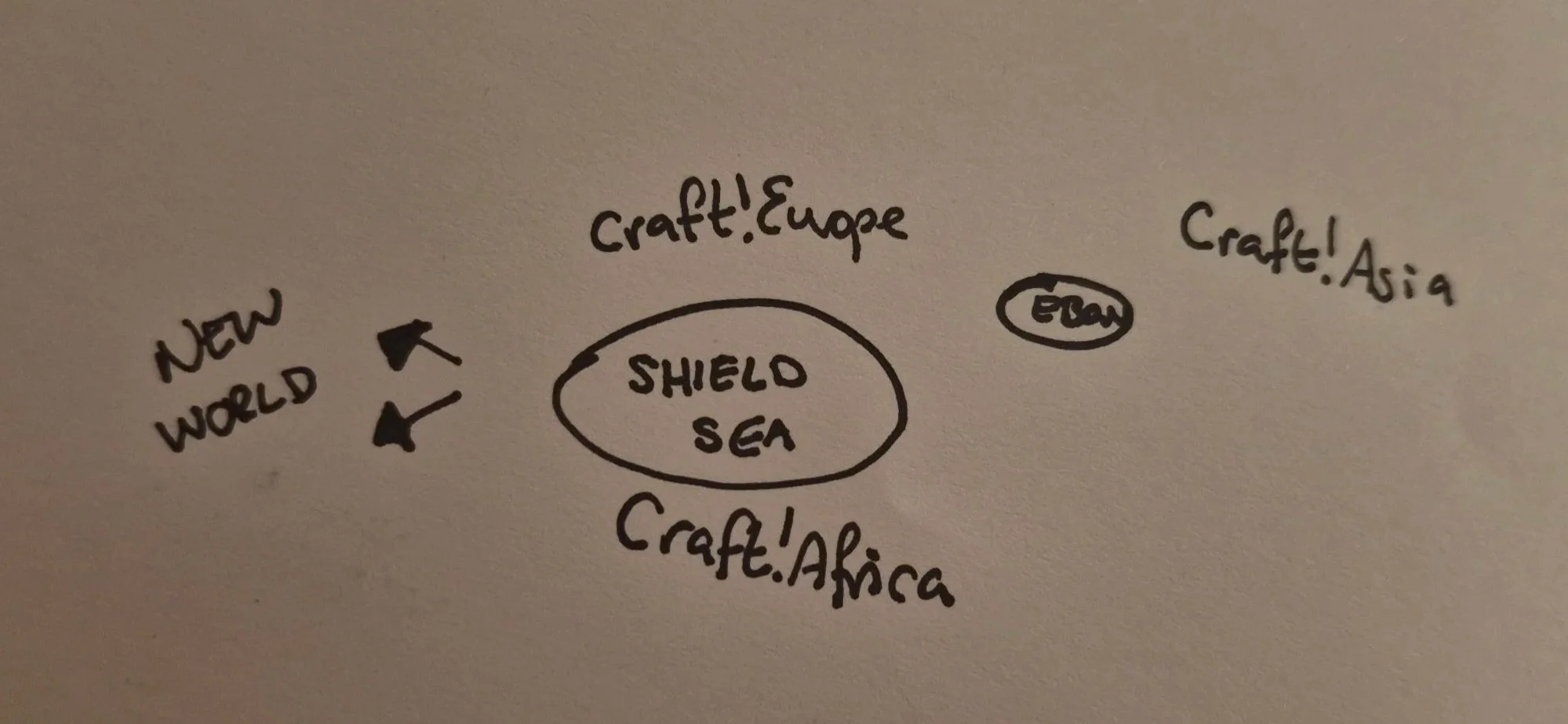
We already know the real world origins of Telomere, Iskar, and Camlaan (more on that below) but this makes it particularly clear that Telomere is Italy. No boot reference, so I’m making it a bit less Italy-looking and more, well, forked prong-y. Iskar is France, and Camlaan is Britain, but I don’t think we have had any confirmation that Camlaan is an island. I am considering mainland Camlaan for the fun of it.
I’m going to come back to Europe proper shortly, but let’s look around the rest of the not-Mediterranean.
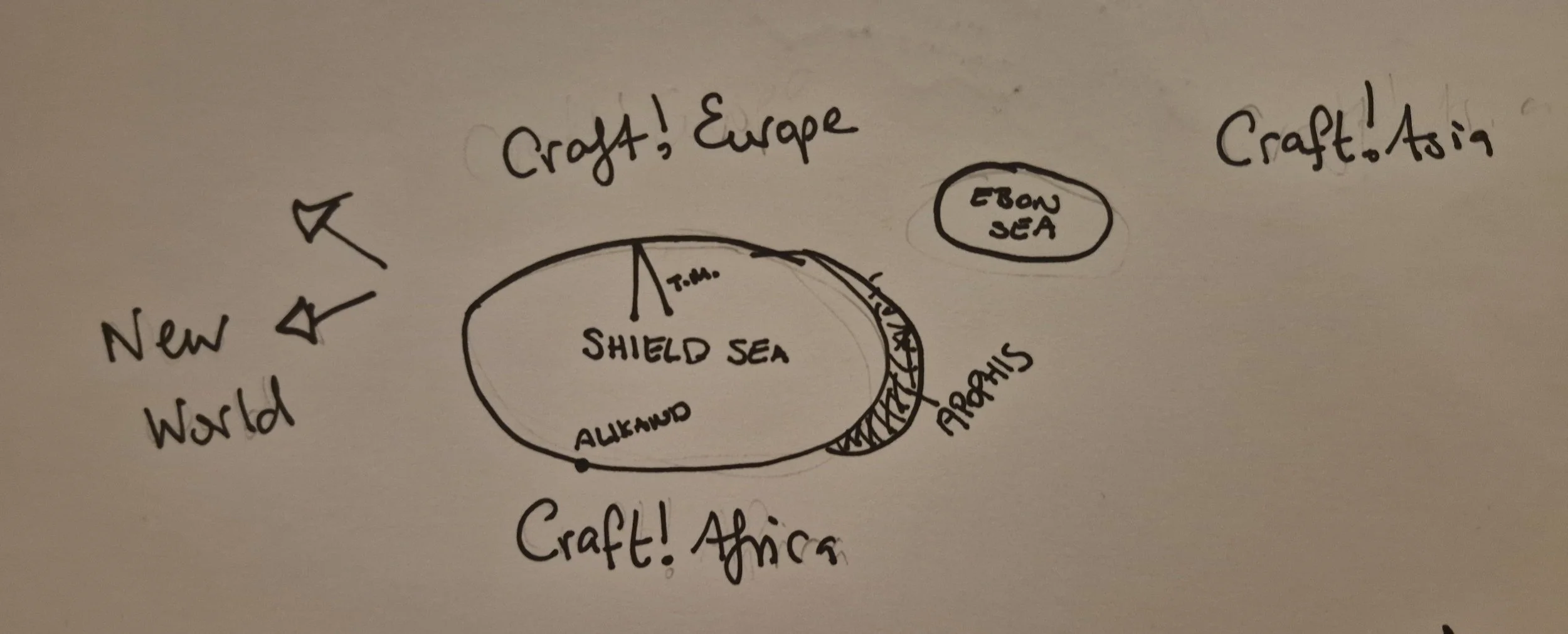
Our main location is Alikand or Agdel Lex. I had thought Levantine (so, eastern Mediterranean) when reading, but Gladstone confirmed last year that he was inspired by Morocco and Algeria. Many of the aforementioned references to the Shield Sea in Ruin of Angels also mention it being north of the city, so I’m placing Alikand in a similar position on the Northern Gleb Shield Sea coast:
We also hear a couple of time about Apophis, which is east of Alikand. The name sounded vaguely Greek to me, so I had subconsciously assumed that was confirmed, but upon reread and discussion with a friend, it seems more likely to be Egypt. Turns out Apophis is an actual Egyptian deity for one, and subsequent references to the Craft Sequence location mention an Apophitan man with a jackal-head (very Ancient Egyptian art) and the game Apophitan ratscrew (we have a real world game called Egyptian ratscrew, apparently). HOWEVER, we also hear about a “Colossus the Apophitans once built” which sounds like Rhodes/Greece to me. Of course, later Ancient Egypt was very Hellenised, so perhaps some kind of combination city/empire works in the Domain?
I’ve decided, partly due to lack of other named locations, to place Apophis kind of hugging the coast between Greece and Egypt’s approx locations, meaning it’s also covering the coastal Levant and Turkey.
Our Shield Sea countries therefore look like this now (still not final blobs):
Which means it’s time to look a little further north.
Craft!Europe
A far as I can tell there is no continent name for Europe and/or Asia, just a general “Old World” description, so alas I must use the old fandom exclamation compound.
We know Craft!Europe is to the north of the Shield Sea, as it is in our world. We have a decent number of city and country references in Craft!Europe compared to other places, so let’s list them out in alphabetical order with their real world counterparts:
Camlaan - Britain
Iskar - France
Schwarzwald - Germany (or Austrian Empire?)
Telomere - Italy
Trälheim - Scandinavia (but possibly not in Craft!Europe)
Zur - Russia (or at least Kyivan Rus)
So not that many, really, but more than one would expect given we’ve only briefly visited even one of them.
Let’s do a quick rundown of why I’ve matched the locations together.
Camlaan is clearly based on Camelot/Arthur, British (but further breakdown below).
Iskar is evidently France judging by the French words used whenever we see Iskari spoken, and by how obviously Chartegnon is Paris.
For the Schwarzwald, I am again basing it on language - the Schwarzwald is actually a real place in real Germany - as we haven’t seen any of it. While Germany has been the main German-speaking power for the past hundred or so years, the Austrian Empire was primary and largest German-speaking polity for many centuries prior.
Telomere sounds less clearly Italian than the other connections I’ve made, but we read about Old Telomere in a way that makes it very obvious Old Telomere is Rome.
Trälheim just looks Scandinavian, no? And it’s described as being hard for a beach bum to adapt to.
With Zur, the clues are again in names (Ivan Karnov, for one), the fact that Koschei rules over at least part of it (Koschei is a name from Russian myth), and the fact that it appears to be located between the Golden Horde (Mongolia) and Craft!Europe. I couldn’t tell in the text how large it was supposed to be, however, so with the shortened “Zur” I made the mental connection with pre-Russian Kyivan Rus. So in my mind it’s not as broad as Russia.
We’re missing quite a few that you might expect, but arguably most could fall under empires and we can say there are more ethnic groups (like much of the rest of the Domain, frankly).
The key one that is missing to me is Spain. We know that Southern Kath has at least SOME Spanish style names (hey Ortega) so one would expect there to be a Spain, surely? Is it part of Iskar? Or a sort of Holy Roman Empire? Eastern Europe is largely missing, but could fall under either an Austrian or Slavic empire, so Schwarzwald or Zur.
I acknowledge I’m getting into some real specifics that I won’t be able to for other continents, but I have more reference points for Europe, and thus more questions.
Given that I am pretty certain Trälheim is not in what we think of as Europe (more on that in a later section), we are looking at five known countries, roughly analogous to the UK, France, Germany/Austria, Italy, and Russia. If they are in similar locations to our world, but roughly contiguous, that means that the roughest of blob maps would make them in these locations:
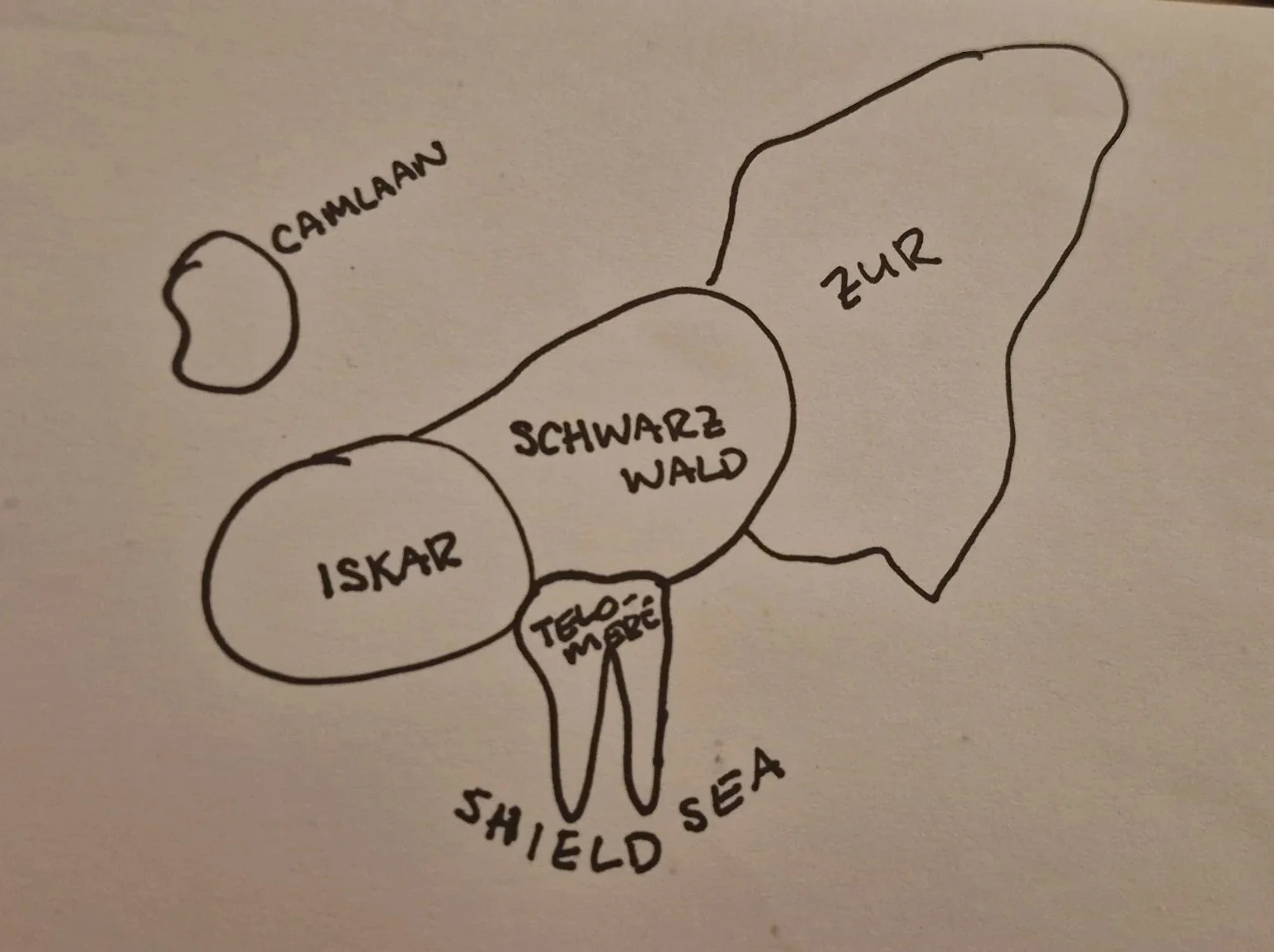
Shall we dare start on a proper (albeit still blobby) map? I think it’s time. The scale is probably extremely off, forgive me.
We’ve got the “forking prongs” of Telomere, Iskar is going more or less to the west (squashed and elongated compared to France to encompass Spain’s part of the Med), and the Schwarzwald to the east (going more with the Austrian Empire kind of size). Zur is even further east, covering the land between Craft!Europe and Craft!Asia around the Ebon Sea (but not as long as Russia, for now at least).
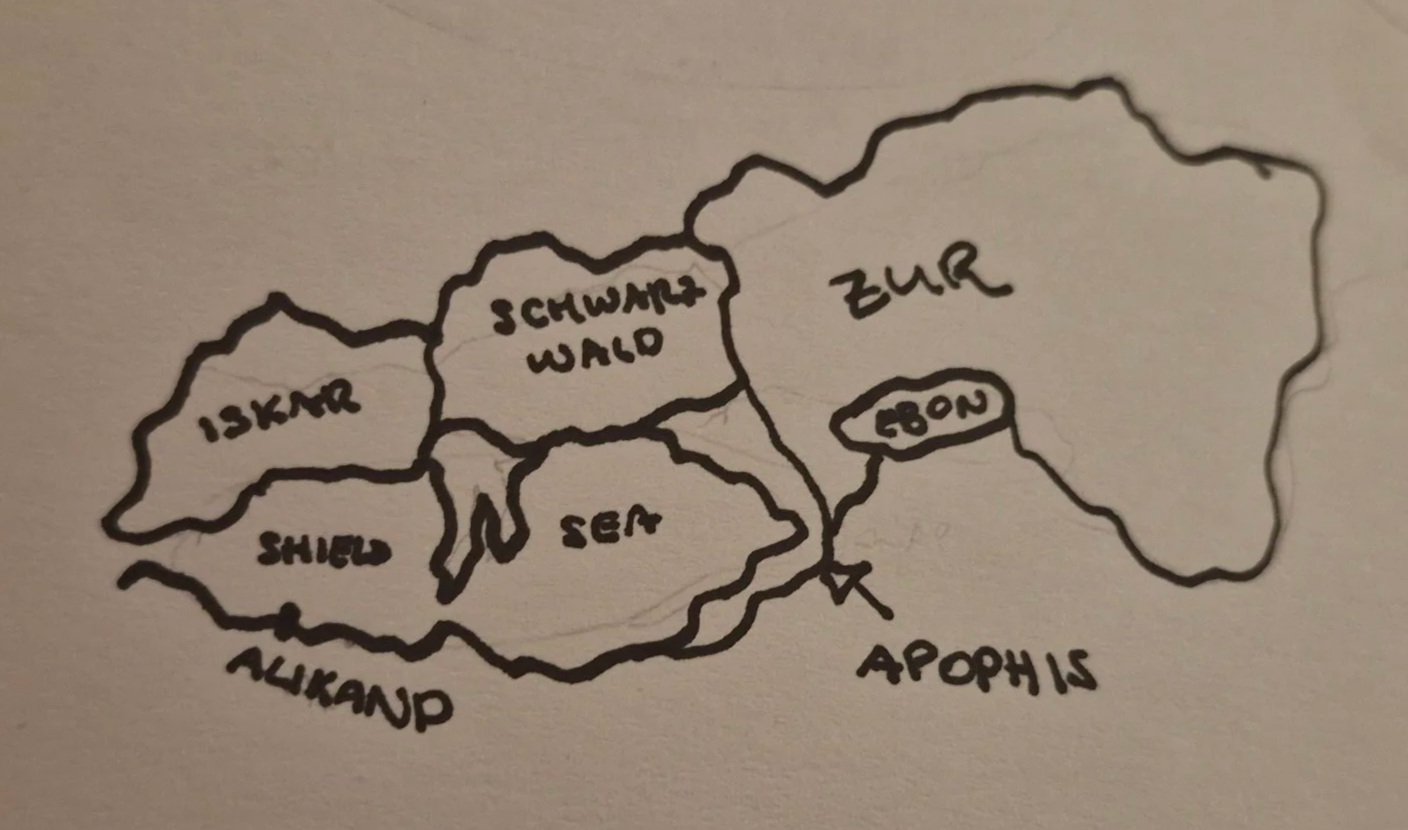
Not convinced by Apophis, I’m going to be honest here. Maybe it needs more islands? Really, I need more locations. Gladstone, please, give me more place names.
Now to Camlaan! As a Brit, this would be my homeland in the Domain so I have Some Thoughts.
Before we met dear old Sir Gav in Dead Hand Rule, I was amusing myself with the idea that England doesn’t really exist. For those less familiar with the idiosyncracies of my silly country, the United Kingdom is made up — controversially to many — of four countries/states/nations: Wales, Scotland, Northern Ireland, and England. England is by far the largest, but also the least Celtic (while Camlaan is clearly inspired by Celtic mythologies). We also have several ‘Crown Dependencies’, which are three self-governing islands that are not part of the UK but also not sovereign states: Guernsey, Jersey, and the Isle of Man.
Camlaan is clearly inspired by Camelot and the Arthurian legends which, although claimed by England, are originally Welsh (or Breton, it seems, from my fact checking).
Okay, I can’t resist another mini tangent within this tangent. Did you know there are two distinct branches of Celtic languages, each of which has three existing languages, with one of each being extinct and recently revived? The Goidelic, or Q-Celtic, branch covers Irish, Scottish Gaelic, and Manx, while the Brythonic, or P-Celtic, branch includes Welsh, Breton, and Cornish. The Arthurian legends are from the Brythonic cultures rather than Goidelic, as far as I am aware.
Oh I’ve come back right before publishing to add another digression (trigression?) A dear friend has pointed out that although the Arthurian myth is not Goidelic, apparently one of the earliest proto-Arthur hero stories says that the hero is from Edinburgh - and thus, potentially Scottish. Yay!
…back to Camlaan.
My Welsh friend and I were discussing Camlaan, and decided that it should be largely Welsh due to the Arthurian-ness. We have had examples of Craft!Scots in the text as “Northern Camlaanders,” exemplified by a ship’s captain in Wicked Problems and her single line of dialogue that is clearly supposed to be in a Scottish accent:
“The lot of ye’ll fit in a single container,” she said, as near as Dawn could make out through the furze of her North Camlaan accent, “and we have a few riding empty. But I don’t think yon beastie will fit, unless he should fold up nice and small.”
And then Dead Hand Rule came in, and Sir Gav was so painfully poshly English that my fanon went out the window. I am choosing to believe there are no south-east English accents, however. Gav and Gal have Welsh accents, or at LEAST regional English accents.
As I said above, I don’t think we have had any confirmation that Camlaan is an island. For my own amusement, I am considering multiple islands for Camlaan, OR a land bridge to Iskar.
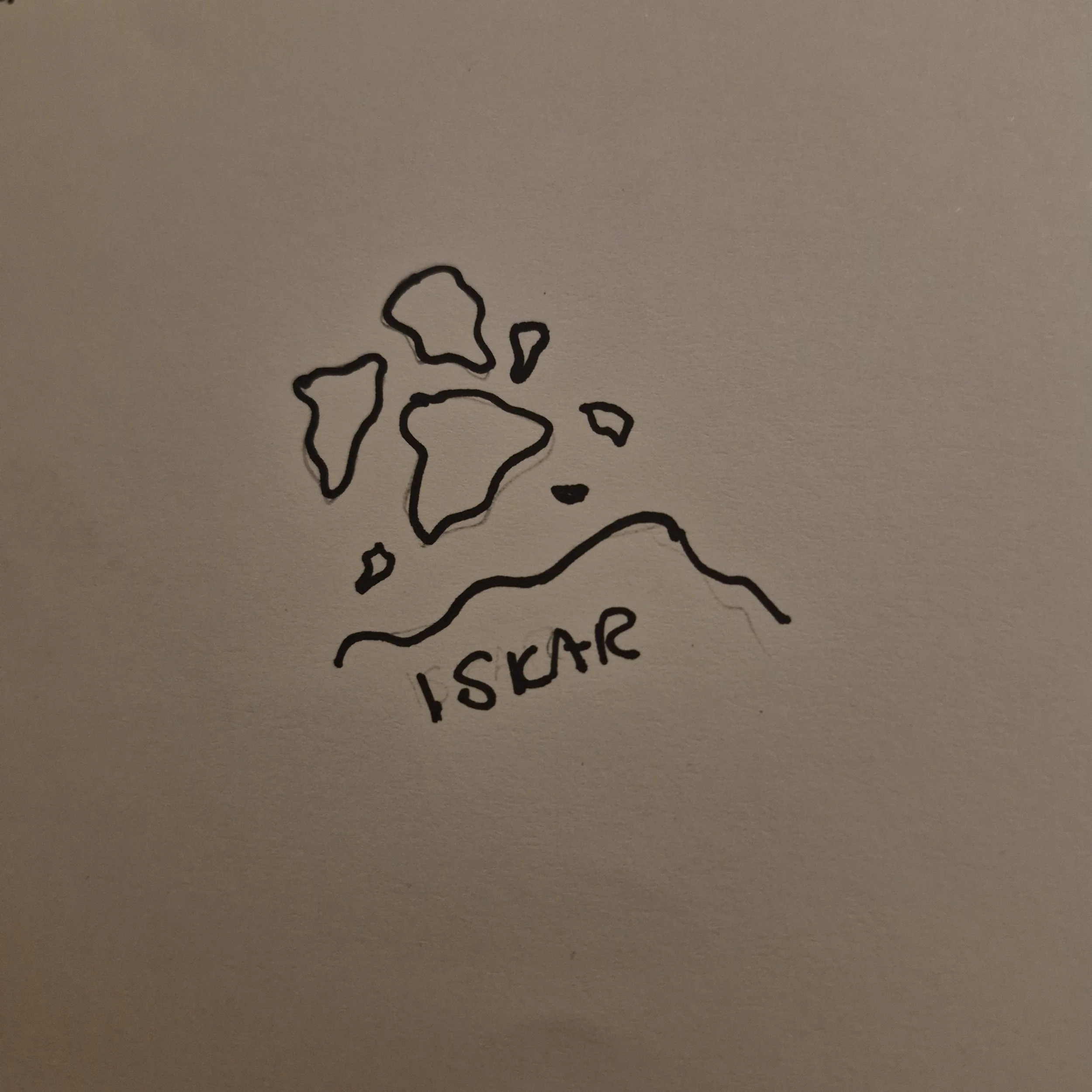
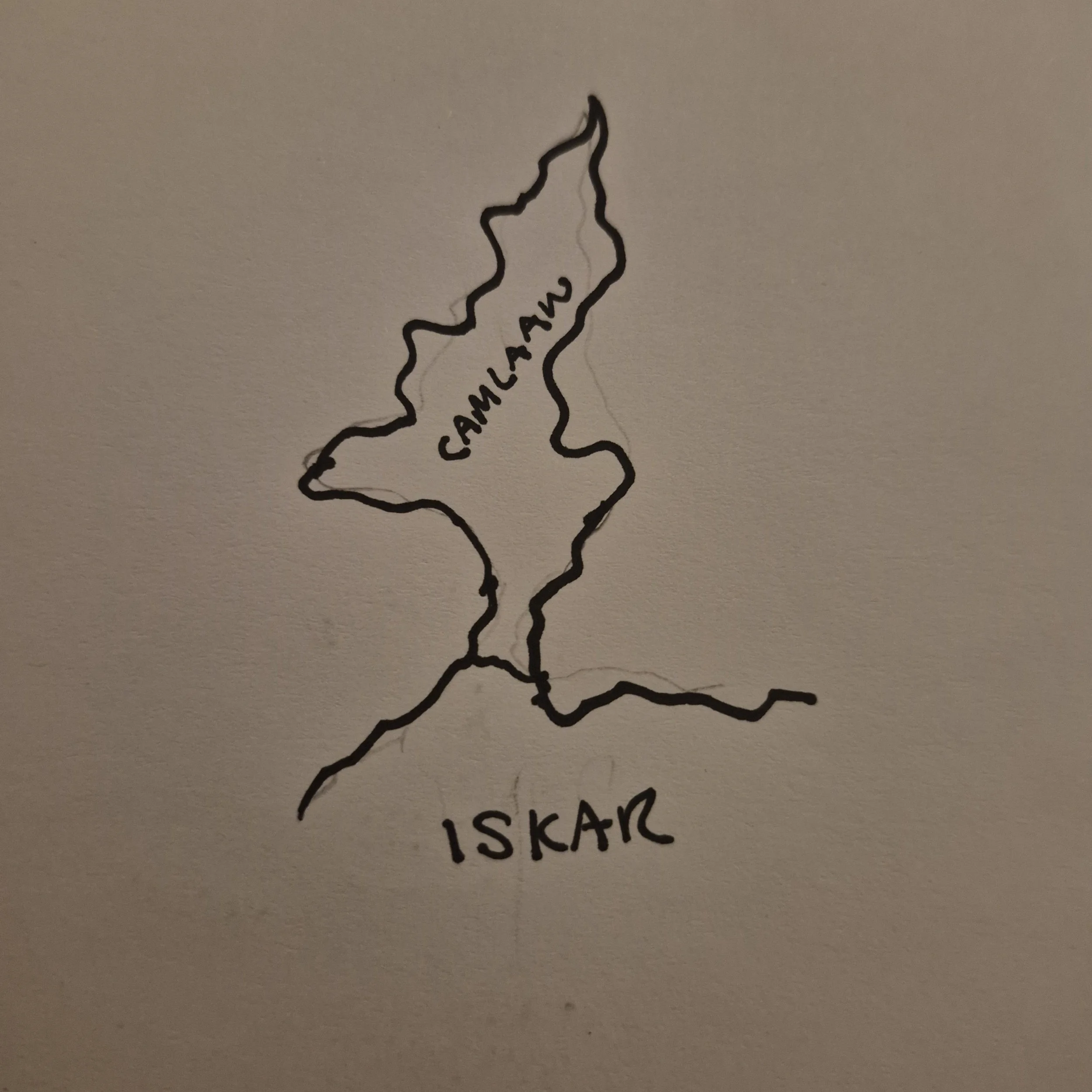
Any preference? Do let me know.
Now, let’s travel east.
Craft!Asia
Once again, we don’t have all that many locations, especially how big real world Asia is. There are going to be some very large cultural generalisations across swaths of real world Asia, so I apologise in advance to anyone whose culture or country is subsumed by the big names. Here’s what we do have, with real world analogs:
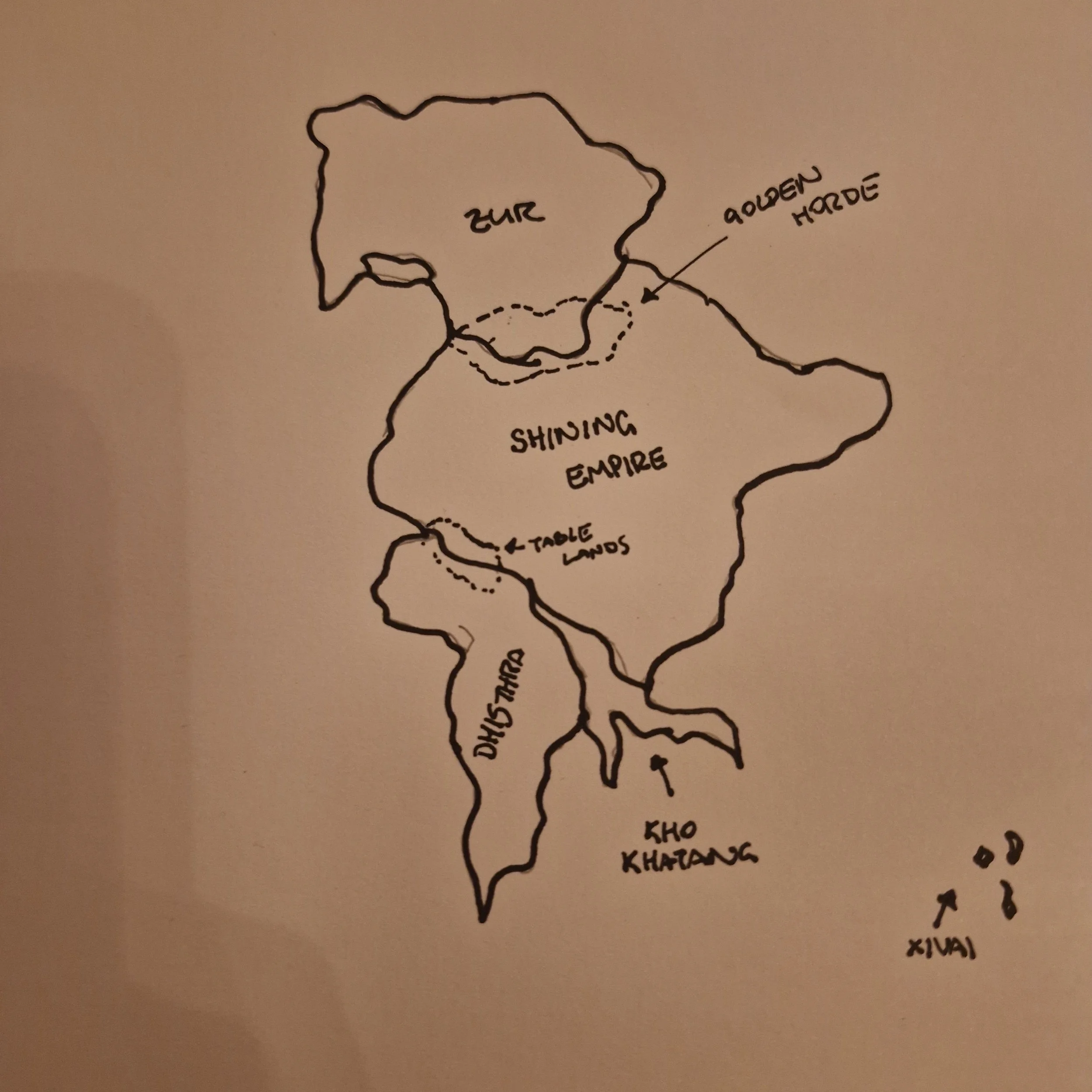
The Shining Empire (China)
Dhisthra / Dhistra (India)
The Golden Horde (Mongolia / nomadic)
Kho Khatang (South-East Asia)
Xivai (Pacific Island?)
We briefly visit the Shining Empire in Wicked Problems, and get some insight into its bureaucracy through Caleb’s friend Ran. The connection with China is a mix of names (to my admittedly amateur eyes, Shenshan Prison, Zheng’an, and Guang’an seem quite clearly Chinese-inspired, and Gladstone has lived in China), allusions to culture and current politics, and importance on the world stage. The Shining Empire seems to be one of the larger polities in the Domain, and obviously has ‘Empire’ directly in its name, so I’m giving it quite a significant land mass (like real world China).
There’s a reference to “the Vinelands between Dhisthra and the Shining Empire,” but not any directions to indicate which place is where. As Dhisthra (or Dhistra depending on the book you’re reading) appears to be India, or at least South Asia, I’m putting it generally south-west of the Shining Empire.
Although we haven’t seen Dhisthra itself, we have seen quite a few things referenced as Dhisthran throughout the series, including a Dhisthran exercise posture that seems to be yoga, Dhisthran sandalwood, a six-armed Dhisthran goddess, and a Dhistran fellow with an elephant head among others. This reads as India (specifically Hindu) inspired in many ways, though I again admit to being an outside amateur. We get a one-off reference to a place called Kalichut, which sounds like it could be South Asian inspired, perhaps a city within Dhisthra?
When I read Vinelands being between Dhisthra and the Shining Empire, I thought of either vineyards or jungle, which doesn’t really work with our real world Himalayan border. There is separately a reference to the “Tablelands” which made me think of the Tibetan Plateau, but I’m rather grasping at straws.
As mentioned earlier, it appears that the Golden Horde represents Mongolia, or at least the ancient Mongol Horde. We have a couple of references other than the name: that the Golden Horde is east of Iskar, that Koschei’s armies “fence with the Golden Horde across the steppe,” that the Golden Horde “rises from the southern Zurish lands” and that it seems unlikely the Golden Horde made it “this far south” into the Shining Empire. I feel quite confident that even if a country like Mongolia doesn’t exist, there is some kind of nomadic culture in the area that is now Mongolia, spreading into parts of the Zur and possibly the Shining Empire.
If we plot these together alongside Zur, without just copying Russia-China-India, we get something like:
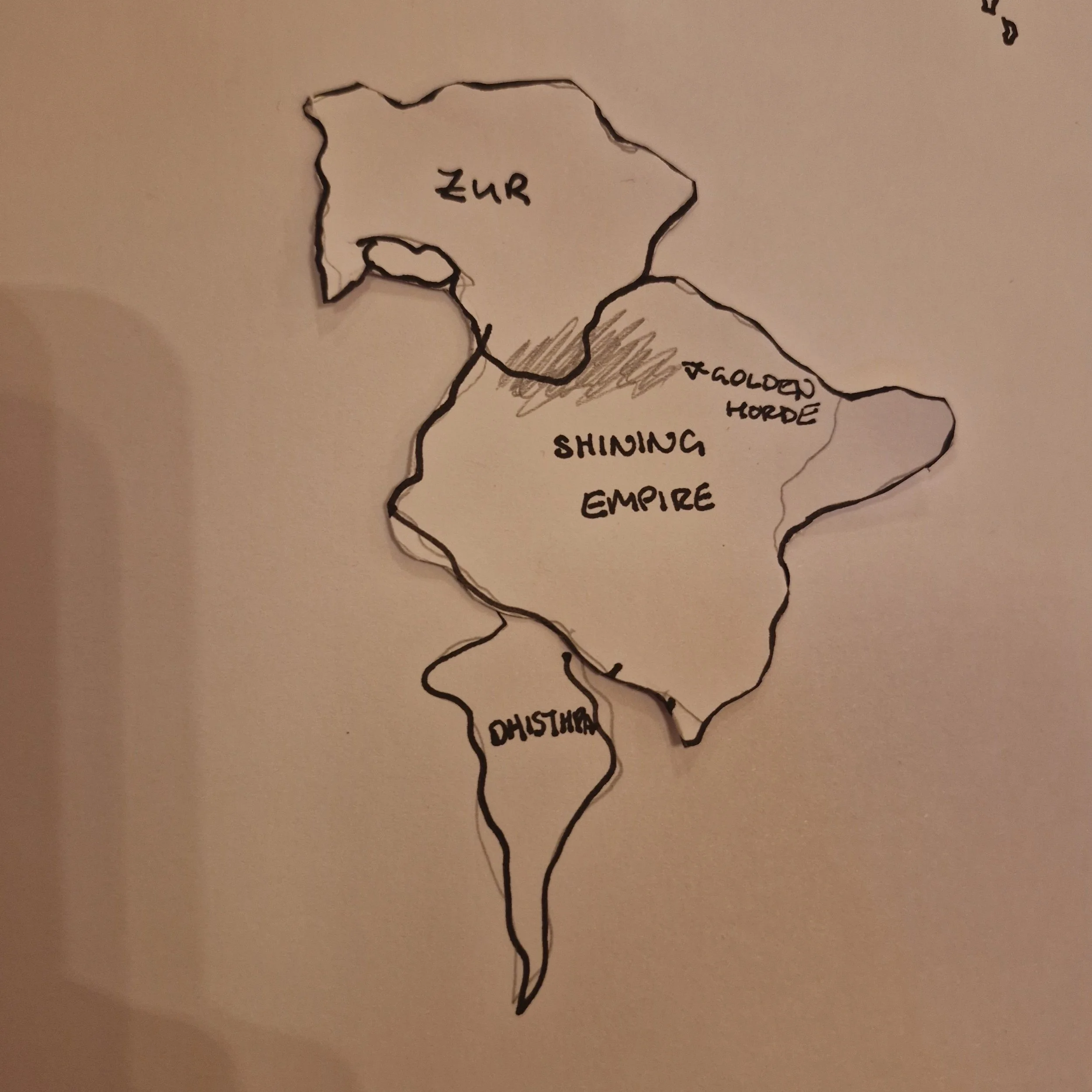
Yes, I have taken to cutting things out and sticking them to other bits of paper. You have no idea how many versions of this I’ve made.
We have far less information on Xivai than any of the above. Judging purely on how it’s written, I thought it was a city within the Shining Empire for a while, until when taking notes I saw Elayne think “Back in the wars she’d shipped out to the Shining Empire from a port in Xivai.” So Xivai can’t be within the Shining Empire. We have only a couple more references:
That some people from the west coast of Northern Kath “cross the ocean Old Worlders call the Pax, to Xivai and the archipelagic West”
That a classmate of Tara’s was a “Xivai beach bum born and bred”
That there is a Xivai merchant marine
And two mentions of whales - whales dancing in the harbor, and whales gathered by the thousands to mate
After speaking to an American friend, who caught some implications I didn’t, it seems that Xivai represents somewhere like Hawai’i or another Pacific island. This works both with the name (Xivai / Hawai), the beachiness, and the whales. The merchant marine thing made my friend think of Guam and American Samoa, US territories in the Pacific with military bases. So I’m placing Xivai somewhere vaguely between Northern Kath and Craft!Asia, in the Pax.
We have a bit more to say about Kho Khatang, thanks to Mako in Full Fathom Five. Back when he was the god Makawe, Mako rowed off to war with his sisters and the strongest Kavekanese fighters. It was a bloodbath.
“We fought south of the Shining Empire, in the islands off Kho Khatang. They needed gods and priests who knew boats and islands and water.”
…
“I took to the skies as a bird of flame, and our warriors clogged the channels. Craftsmen rode in on dragonback, and demon chariots that trailed lightning. Clinging fire fell. They poisoned the land and sea. They poisoned time. The Carrion Queen and the Blade Child caught me in the sky, and our battle burned. Unlucky travelers who visit the delta at night see echoes of our struggle, and go mad.” He breathed, ragged. “We died. All of us but me. And I woke blind and broken.”
There are many horrors of war in the Craft Sequence, but this specifically reads to me as alluding to the Vietnam war through a Craft lens. Kai recalls as a child reading reports of war in Kho Khatang with body counts rising. This is long past the God Wars, so clearly there is continued violence. The God Wars cover a far longer period than our World Wars, and represent both that and the Industrial Revolution, so we can’t do a one-for-one match, but I wonder if ongoing wars in Kho Khatang is referencing the post-World War II wars in South-East Asia, between the 1950s and 1960s? We learn virtually none of this part of history in UK schools, so if I’m totally off-base do let me know.
We also get the intriguing piece of information that Tara and Kai’s fake Iskari identities are “attested and sealed Kho Khatang passports [for] first-time visitors to the metropole.” This implies that Kho Khatang is part of Iskar. Historically, much of South-East Asia was under French colonial rule, and we know Iskar is still trying to increase its influence around the Domain including getting its tentacles on Kavekana.
So, I am putting Kho Khatang roughly where Vietnam, Cambodia, Laos and such are in our world, but also pushing it a little between part of Dhisthra and the Shining Empire to give us the Vinelands. This gives us the following for Craft!Asia and the Pacific:
Anything I’ve missed?
The Gleb - Craft!Africa
We actually do have a proper name for Africa - the Gleb or Gleblands.
Unfortunately we have even less information about locations within the continent than we do for Craft!Asia or Southern Kath. One of my many hopes for the future of the Craft Sequence is standalone stories in different parts of the world, perhaps co-written or somehow franchised out to writers from different backgrounds. I’d love to see how other writers play in the Craft Sequence sandbox, as much as I love Gladstone’s own writing.
We’ve already looked at a little of the Northern Gleb around the Shield Sea: specifically Alikand/Agdel Lex and potentially Apophis. What else do we know about this continent?
Rather than specific polity names, we tend to hear about larger swathes of the Gleb, generally categorised as the Northern or Southern Gleb - but we do get a single reference to the Western Gleb, which intrigues me.
Alikand is in the Northern Gleb, and Izza comes from somewhere here as well. The dominant culture is Talbeg, which seems to be large and spread out. Izza’s Talbeg is different than the Talbeg of Alikanders; much, I think, like there are several major varieties of Arabic such as Maghrebi, Egyptian, and Peninsular Arabic.
Our first reference to the Northern Gleb, however, comes as early as Three Parts Dead. Elayne introduces Abelard to the major Deathless Kings of Alt Coulumb, including Plenipotentiary James Regulum of the Northern Gleb. Now, that’s a very English sounding name, I hear you say. You’re not wrong. Elayne tells Abelard that James is “One of the first generation of Craftsmen. His people were colonists of the Northern Gleb for Camlaan, and remained through the Wars to found one of the first true Deathless King nations.”
So, British colonists.
The Northern Gleb was torn apart at the very start of the God Wars, with Maestre Gerhardt and his followers “shredding” the land, forming the God Wastes and the wound at the heart of Old Alikand that we see in such detail in Ruin of Angels. The Northern Gleb has not seen much peace since.
When Izza tells Cat she’s from the Northern Gleb, Cat’s response is:
“Shit.” Cat looked up at her, eyes wide, and Izza saw behind those eyes the twist of thought she hated, that she’d run from the Old World to escape: the sudden re-evaluation, the swell of pity. “Sorry. I didn’t—”
“No,” Izza said. “Not … It’s fine.” And wasn’t.
“When did you leave?”
“When there was nothing left to leave. When they burned my village out.”
“Which they?”
“Does it matter?” Izza said, but Cat didn’t look away, didn’t let the subject drop. “They came at night. They dragged us to the priestess’s house first, killed her family and then her. A knife across the throat, just like that. Then they took others. My folks. I guess they wanted the kids for … for whatever. Everyone watched. The gods screamed. I ran. We all should have run. Right? Weeks before, years, when Clock’s Raiders and the One Gleb and the Khalaveri started fighting. But a whole town doesn’t run together. They stand strong until they break, and then they all run in pieces.”
This appears to be the story of many child refugees who end up in Agdel Lex, as Izza originally did. When back in the city, she hunts down her old friend Isaak and later gets locked up in an orphanage of kids like her:
They’d been kids together, or whatever you were when you were eight and bleeding, smeared with filth in a rail depot in some fucking Camlaander Peace Station where Knights gathered in quest of something that wasn’t Empire but sure as all hells wasn’t Peace, in a place you barely knew to call the Northern Gleb in the middle of something newspapers were careful not to call a war, clutching a person your age who seemed nearly as fucked as you.
…
They had come from across the Gleb, and spoke different languages, and cared about different things, and all were hurt and angry and sad and lost.
So we have burned out villages, child refugees fleeing across the continent, Deathless King colonists, and King Clock’s Raiders. King Clock has been mentioned a few times but we have so little knowledge about who he is and where he came from that I struggle to say much more here.
A few more Northern Gleb references continue to mention war and massacres. It’s described as “a hothouse of warring Gods and Craftsmen using one another as catspaws” and “the sectarian madness of the Northern Gleb.” We read that, unsurprisingly, the Deathless Kings of the Northern Gleb have trade agreements based on “raw material exports.”
I don’t have a great deal to add to the map, I’m afraid, other than “Deathless King and King Clock’s territories.”
We are yet to visit anywhere in the Southern Gleb, but it seems highly likely to represent sub-Saharan Africa. Once again we know very little about specific cultures, cities, countries, or even gods. We know that Tara’s mother’s family originated there, and references to their family name (Ngoye) and some of the old stories Valentine told Tara ”about rabbits and spiders and other thieves” sound to me like stories from West African cultures, some of which were brought to North America via enslaved folks and have evolved into new myths. There is a brief reference to a “Xbel mask from the Southern Gleb.” Whilst there are, of course, huge numbers of languages in sub-Saharan Africa (a quick search tells me over a thousand), Xbel looks potentially inspired by a Southern African language like Xhosa.
There are further references to the fact that humanity evolved “probably in the Southern Gleb,” another clear reflection of our world. And there are the same old Deathless Kings causing hardship and chaos. They “rule the cities while hungry men and gods scrap over bloodstone mines” - sadly, yet another reflection. Gladstone tells us that “half the Gleb’s at war” and “you read about revolutions and regime changes all the time in the Gleb.” Sounds a lot like how much of Europe and North America views Africa.
Alas, this is very unhelpful for my map. I have no place names at all. So our final map of the Gleb is simply this, with climate regions indicated rather than locations. Assume lots of Deathless Kingdoms and King Clock’s wasteland:
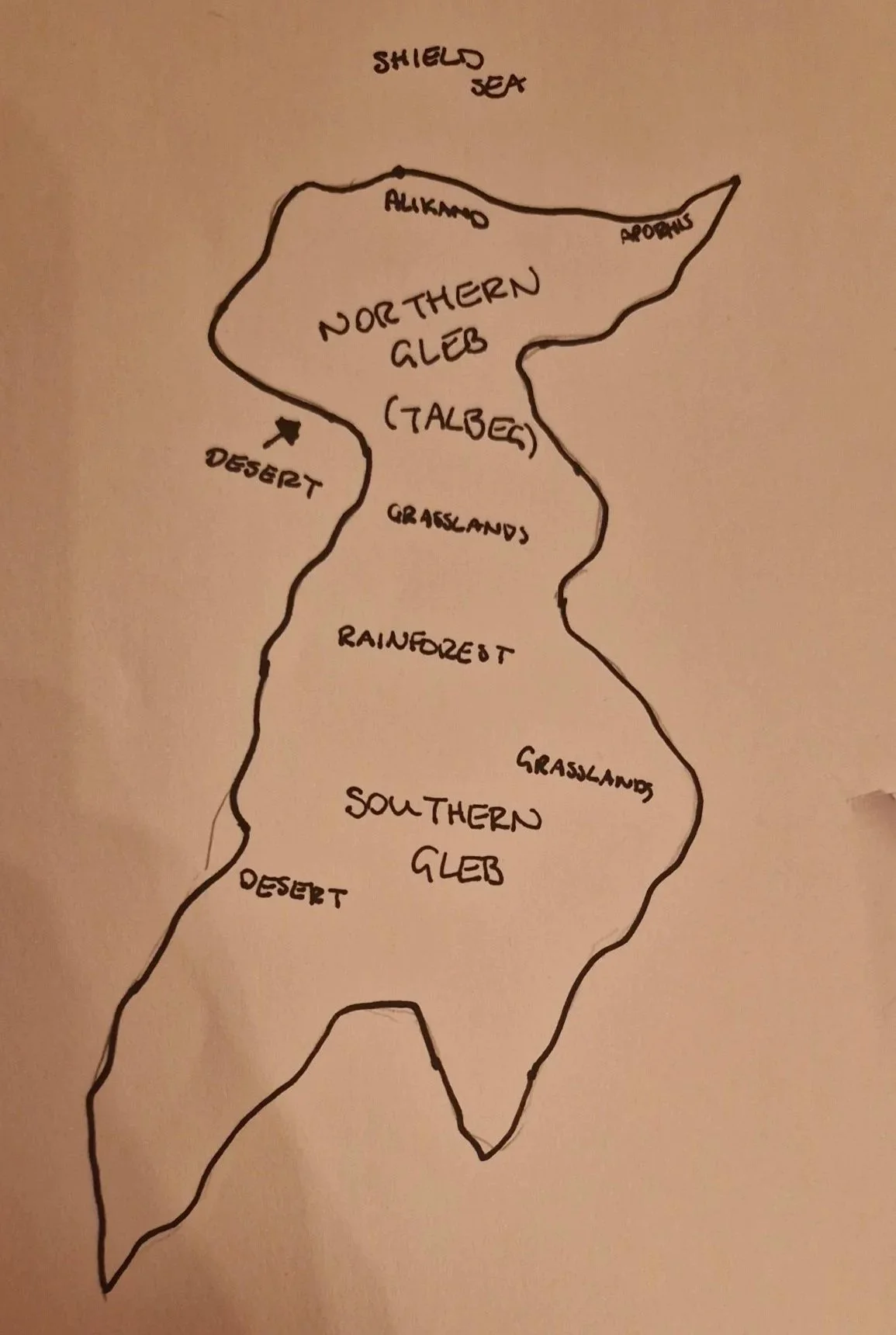
I’ve struggled a bit with the intersection of the Gleb, Craft!Asia, and Craft!Europe - equivalents of the Caucasus, the Middle East (or South-West Asia, as I believe people are beginning to call it?) - so that’s remaining blank. Imagine some Deathless Kings hanging out there. Or perhaps this is still part of the Northern Gleb? Let me know what you think.
We’ve covered off the major continents (as I don’t think we have an Australia), but something is missing…
The Skeld Archipelago
You might have noticed that I haven’t mentioned Kavekana yet, nor come back to my earlier point about Trälheim not being in Craft!Europe.
That’s because we haven’t yet talked about the Skeld Archipelago.
I discussed this in my Untangling Dead Hand Rule series in a slight (lol) digression, so I’m going to repeat and paraphrase myself rather than invent new ways of saying the same information. If it sounds familiar, gold star for religiously (or Craftigiously?) reading all my essays.
We know from Gladstone’s recent AMAs that the Craft equivalent of the Atlantic Ocean is dotted with islands, which made travel across the ocean easier historically; immigration patterns to the New World are thus very different than ours. This appears likely to be the Skeld Archipelago.
I was confused by Tara, Dawn, and Mal ending up in a Skeld glacier at the end of Dead Hand Rule, because I had thought the Skeld Archipelago was home to Kavekana whereas this felt more Arctic. It certainly seems from various direction and travel references that, despite being culturally akin to the Pacific Islands, Kavekana is between Northern Kath and Craft!Europe, as is Skeld. So let’s take a look at all our references.
There are seven references in Dead Hand Rule alone. We see “the farthest frozen reaches of Skeld” on page 13, and “a classic Skeldic beauty, blond and pale and tall” on page 166. There’s another reference to Skeldic ship-folk being “pale-skinned” on page 262. This sounds Vikings to me, and thus Scandinavia.
THAT BEING SAID.
In Three Parts Dead and short story Man in the Middle, we hear of “the Skeld Archipelago” in reference being a “god-haven” and having “Iskari colonies”, or connected to “Kavekanese beachcombers” respectively. Denovo claims to have been in “the Skeld Archipelago” prior to arriving in Alt Coulumb and we hear of the “Siege of Skeld” when Tara’s parents were teenagers, but that doesn’t help us with any kind of location. The Skeld Archipelago and Skeld Reaches are also mentioned in Two Serpents Rise but can’t be connected specifically to the archipelago Kavekana is part of. Last First Snow mentions the Skeld Archipelago as running subsidiary warding idols, and also mentions “tales of ice-locked Skeldic ships back in the ages of polar expedition.”
Skeld comes up in Four Roads Cross as having “small gods and sunken cities,” and Skeld rugs are mentioned here, in Three Parts Dead, and in Ruin of Angels. Yet, other than the language reference, Skeld is not mentioned in Kai’s POV or on Kavekana at all.
Honestly, I feel like this is probably one of Gladstone’s minor retcons that nobody other than me would notice. I think it was originally intended to be the Archipelago where you find Kavekana - see god-haven, warding idols, Iskari colonies, and the reference to Kavekana. The lack of any reference to Skeld in Full Fathom Five and the abrupt change to connecting ice with Skeld makes me think that Gladstone either forgot how he used the term originally, or decided it didn’t work with the Hawaiian inspired culture of Kavekana.
Yet we still have a Skeld Archipelago, and they are apparently making idols or small gods!
I have two solutions. Either we have two completely unrelated archipelagos that both happen to make idols, or the archipelago is so massive that these references are for the same place.
I am inclined towards the latter, that there is a massive Skeld Archipelago stretching from the equator to the poles. This would be the most satisfying solution for me, but does mean the reference to pale Skeldic beauties and ship-folk seems odd as Skeldic would refer to a huge range of ethnicities. We also, I realised on my most recent note taking reread, have a reference to a Skaldic painting, which is probably a typo but I wanted to flag it too. And although I don’t have the full text of the games, there is in fact a reference to “mead halls of the warrior-kingpins of northern Skael.”
Choice of the Deathless was published in, I believe, 2013, making it older than all but the first two books. I now speculate that the Scandinavian cognate was supposed to be Skael, the god-havens Skeld, and the two either became confused or Gladstone decided to throw them together.
All that to say…I’m putting the Skeld Archipelago as a massive island chain down the equivalent of the Atlantic Ocean, with Kavekana somewhere around the equator. As we now have lots of Scandi references for Skeld, I am also positioning Trälheim here in the far north.
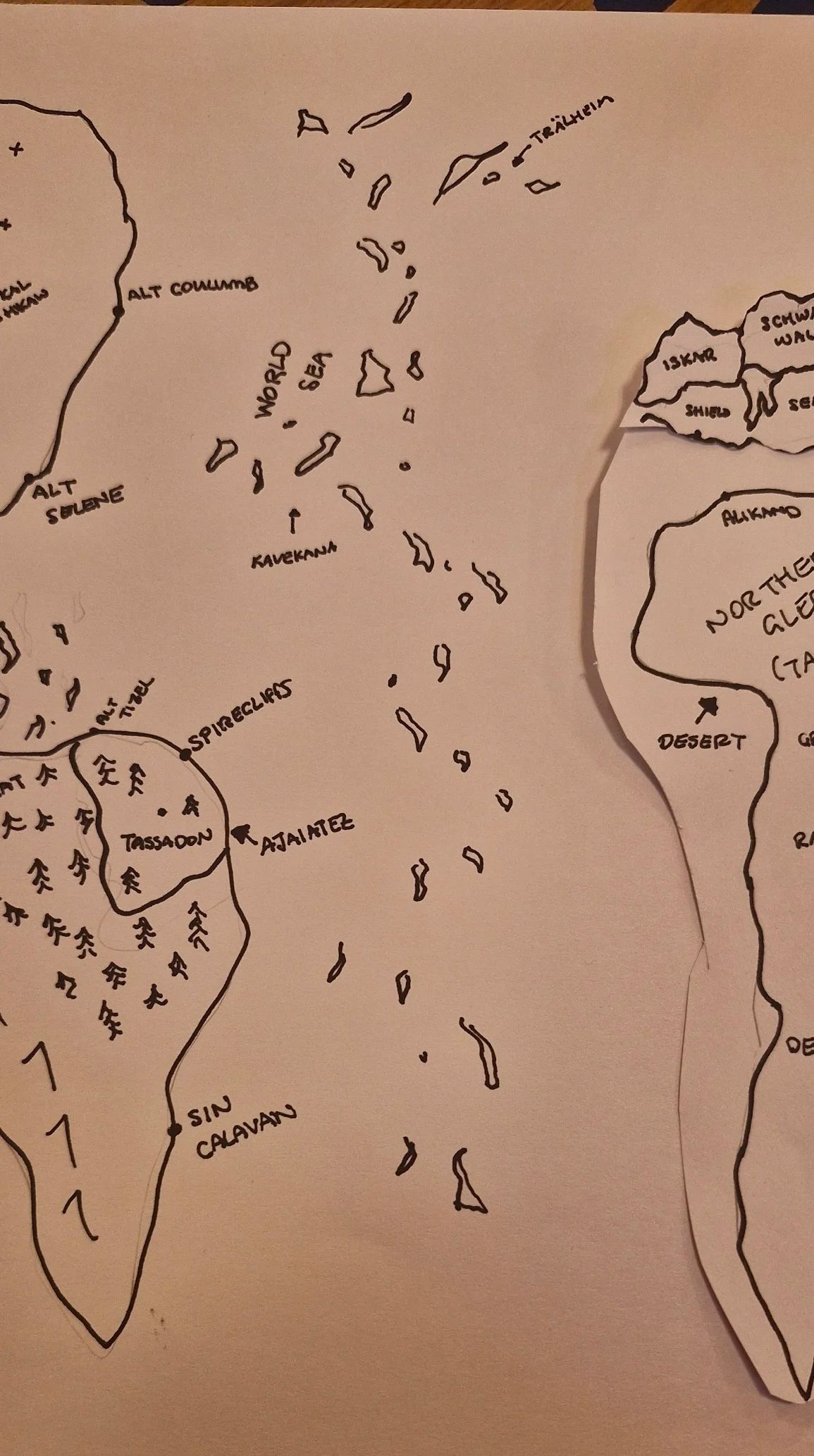
Final (for now) world map of the Domain
For purposes of this map, I have decided to go with the option of Camlaan being attached to the mainland rather than being several islands. I also slightly moved the edges of the Gleb and where it connects into Craft!Asia and Craft!Europe, and Iskar so we can close of the oval of the Shield Sea.
I must also add that I found one more location reference in Southern Kath while going through a final scan of the books! At the start of Wicked Problems, Caleb meets an assortment of journalists who “had come together in a van from Alt Tizel.” This is our one and only reference, so I have no directions from the spirecliffs other than Alt Tizel presumably being a driveable distance. Driveable distance means very different things to different people, but as I don’t exactly have a scale on this map, I’ve place Alt Tizel relatively close to Ajaiatez.
I also recall a reference to another place name, used along the lines of “you could stretch xyz from Alaska to Antarctica” that appears to mean a very far away place (Australia? Antarctica?) but can I find said reference now I’m looking? No. I cannot. So I may come back to this next time I do a full reread.
With those additions and caveats, here is my map of the Domain:
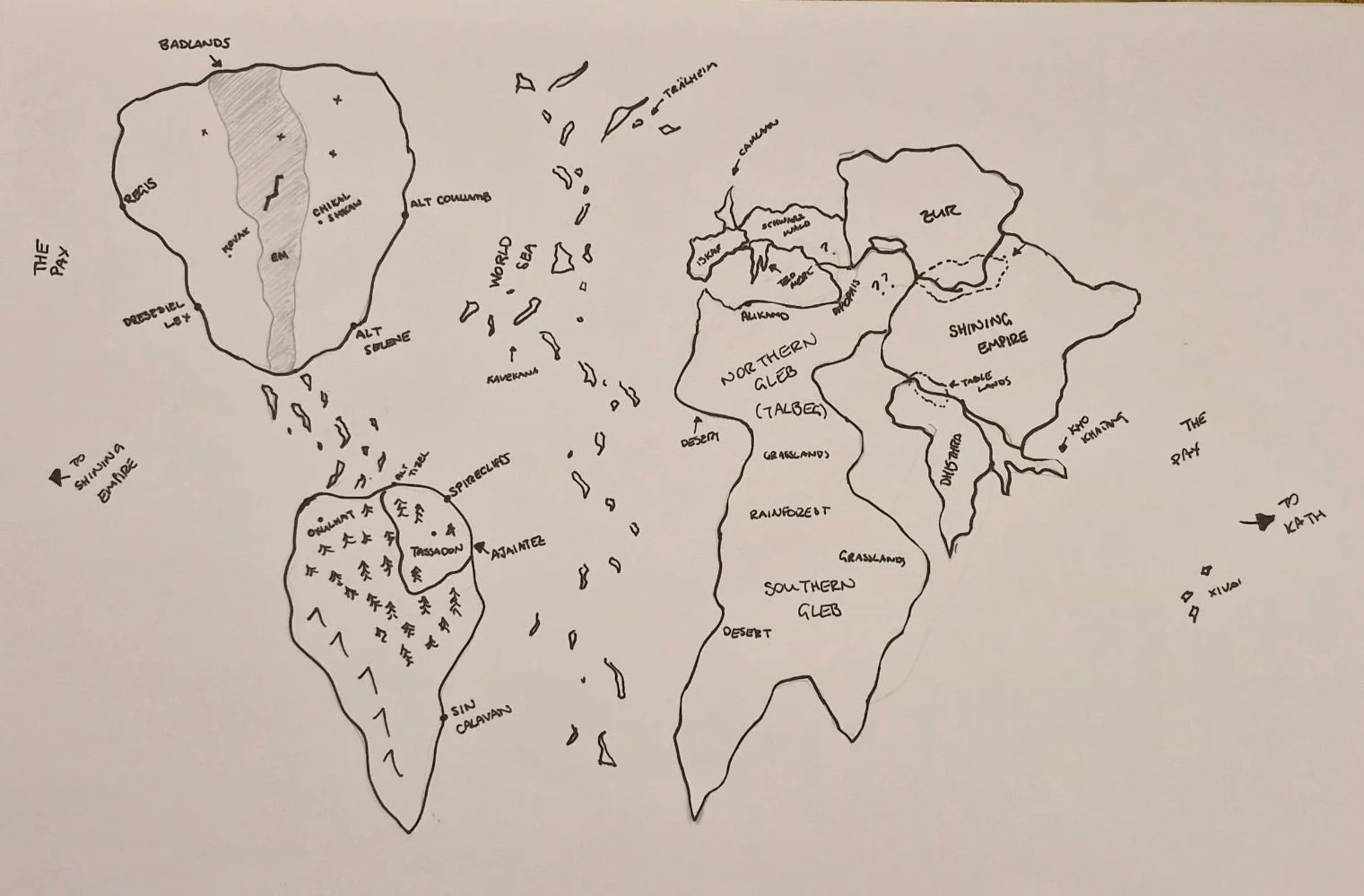
Am I slightly regretting making Southern Kath look so like our real South America while I went off-piste with the Old World? Kinda. Am I going to change it? Not after the amount of versions and cutting out I’ve already done. This is it for now.
Perhaps we will get more information soon, which I can use to amend the map. Perhaps someone with artistic skill will turn my blobs into a proper map! And, of course, perhaps the skazzerai will destroy the Domain and everything on it so there will be no more map to have.
What do you think? Let me know!
Get early access to all essays and audio content by joining the new Hidden Schools’ Craftwork Department (aka Ko-Fi membership)! Higher tiers mean you get to vote on or commission future topics, as well as knowing you’re keeping the site alive.
Not able to support financially? Totally understand - you can subscribe to get email notifications about new essays and other fun projects in the pipeline.





Sometimes essays are serious and in-depth and speculative. Sometimes I decide to rename the books for no good reason. This is the latter.